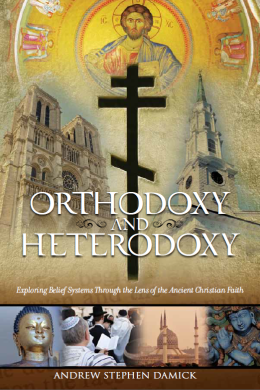
Roads from Emmaus is the personal weblog of the Rev. Fr. Andrew Stephen Damick, pastor of St. Paul Orthodox Christian Church of Emmaus, Pennsylvania, author of Orthodoxy and Heterodoxy: Exploring Belief Systems Through the Lens of the Ancient Christian Faith (available from Conciliar Press and via Amazon.com) and host of the Orthodoxy and Heterodoxy and Roads from Emmaus podcasts.
Internet Discourse and the Fear of Death

When I was studying Hamlet in college (which I did several times, being something of an addict for that story, despite my claims at The Tempest being my favorite of the Bard’s plays; I once took a class in which we spent three weeks on “Who’s there?”), if there is one thing I learned that the poor Dane learned too late, it was this: We all die. Indeed, we are all dying. The play is essentially Hamlet’s attempts to come to grips with this truth, but not before his inability to deal with death deals quite a lot of death in the meantime. Funny thing, that.
As such, when I was recently dared into an online debate by a 70-year-old atheist regarding the basis for my religious belief (as if anyone believes in “religion”), it occurred to me more than once that perhaps this pastime must be something like playing golf is for many people, an amusing distraction to bide the time until admission to assisted living, hospice, and then the cold, hard dirt itself. What does a 70-year-old atheist want with trying to convince a priest that he’s necessarily mentally deficient by virtue of believing in something beyond what his eyes see?
But it seems that so much Internet discourse runs along these lines, making the assumption that those involved must have all the time they could ever want. This assumption reveals itself typically with the claim by one of the conversants that, unless the other is willing to engage him and hash through all that stuff with him, he must be a coward, ignoramus, etc. If someone walks away, he is of course admitting that he is wrong. It is never believed when one says that he has been through all this before and doesn’t particularly want to go through it all again. He is not, after all, immortal, and he has things he wants to do before he dies.
The Scripture actually tells us that sin itself is often the result of the fear of death. Fear of death in our own day typically manifests itself in two ways, an obsessive emphasis on the physical body by means of dedication to pleasure, healthcare, etc., and the atemporality of (the usually unspoken) assumption of immortality. That is, either we fear death by trying to extend and enlarge our physical life as much as we can, or we fear death by denying its very reality. (And often, we do both.) In the case of much Internet discussion, the latter is the typical characteristic.
I must admit to having fallen into this trap on many occasions, but I am more often constrained from doing so lately by having more things to do and (most frequently) by being tired of the expectation that I engage in the same back-and-forth with another person who was not there when I did it before. No doubt he’s done it before but hasn’t tired of it yet. We might be accused of a lack of evangelistic zeal when not wanting to dive yet again into this same quagmire of endless oneupsmanship, but even the Lord said that sometimes it’s necessary just to move on. Some make it their mission to keep trudging down these paths, and perhaps that really is their mission.
As for me, though, I’m going to die someday—perhaps today, perhaps tomorrow, perhaps sixty years from now. I’ve already got my funeral home picked out, though I do still have some work to do on picking a cemetery plot.
Upcoming Series: Foundations of the Orthodox Faith
Samuel Johnson’s Foot
The great lexicographer Dr. Samuel Johnson, who it is said was once asked how he knew something was real. In response, he walked up to a tree and kicked it. This is a proper and robust environmentalism cum epistemology.
The following is an excerpt from a much longer talk I wrote but did not deliver, as I learned the day before the event that it was desired that I deliver a very different sort of lecture. The essential thrust of the talk, written for a mixed audience of both believers and unbelievers, was to prepare them to receive the Gospel, in this case, specifically by encouraging them to look at knowledge as something that is not mainly information but participation. This talk is titled “What is Truth?”
I have an atheist friend who believes that it should be illegal for parents to expect their minor children to follow their religion. When I asked him why he believed that, he said that it was because the kinds of claims that religion makes are inherently non-falsifiable. If you’ve not encountered the term falsifiable before, I won’t annoy you with a complex philosophical definition, but you should at least know that it refers to a truth claim that could be proven true or false by anyone.
An example of a falsifiable truth claim is that Barack Obama is currently the president of the United States. The evidence to prove or disprove that claim is fairly available to all, assuming, of course, that we are not trying to thwart the Secret Service. A non-falsifiable truth claim would be something like this: Zeus is the ruler of all the gods. We do not have the gods at hand to interview as to whether their fealty has indeed been sworn to Zeus, nor are we likely to be able to get Zeus himself to speak in front of a congressional committee, to offer testimony regarding the part he plays in Olympian politics.
Thus, falsifiable truth claims are the sort of thing that can be scientifically, objectively proven, while non-falsifiable truth claims cannot be addressed within the context of objective science.
My friend is, of course, quite sincere in his belief that children should not be subjected to participation in non-falsifiable truth claims. There are, however, a number of problems with his position that parents should be prohibited by law from teaching their religion to their children and encouraging their participation in it. Such a law would, for instance, make it illegal for Roman Catholics to have their babies baptized or for Jews to circumcise their sons on the eighth day after their birth. But even aside from the disturbing political issue of suggesting that the state is a better arbiter of parental practice than parents, there remains the question of why it is that only falsifiable truth claims should be taught to children.
Anyone who has ever tried to raise a child knows that most parenting time is not spent on falsifiable truth claims. Indeed, claims such as “It is good for you to stop hitting your brother” are not provable by scientific means. In fact, science might suggest that hitting your brother is an excellent idea, because it helps to keep you in control of his toys. This sort of thing could be said about any moral claims, and although we take many of them for granted, such as the Golden Rule, there really is no hard science which demands that we live that way. In fact, science never says that we ought to live one way or another, but childrearing is precisely about teaching how one ought to live.
The truth of our human existence is that the noblest, most powerful, compassionate, beautiful, and remarkable things in life are almost never undergirded by purely falsifiable truth claims. So why would we want to deprive children of these things, even if we were capable of totally shielding them from such experiences? Who better than loving parents to feed children not just with physical nourishment but nutrition in what is at the heart of humanity? (Of course, loving parents are an inherently non-falsifiable phenomenon!) But supposedly, this is the best way to apprehend the truth without religious or philosophical bias, so that only facts may be known.
What underlies this whole approach to knowing the truth is the notion that truth is a piece of information. If truth is, indeed, only information, then of course it can be reduced to the category of fact. Much of our culture’s behavior is based on this characterization of truth, which is why studies and claims clothed in the language of science and fact are given so very much stock in public discourse, while appeals to higher, nobler kinds of truth typically find their way into the public square only in terms of sentiment. But when we mean business, when we’re being really serious, then we bring out the falsifiable truth claims. That’s when we want men in white coats doing something called “science,” giving us something we call “facts.”
One of the underlying assumptions of our modern idea about truth is that it should be objectively true, no matter what anyone’s particular subjective experiences tell them are true. That’s why we have peer-reviewed scientific journals, so that other scientists can check on the claims of their peers. But underneath this model of knowledge is the idea that we can know things simply by observing them. If we are somehow personally involved in the experiment—for instance, by using ourselves as test subjects—then the results are suspect.
Yet the reality of human existence is that most of us do not solely take up supposedly objective, distinterested means in order to make decisions and live life. For instance, it is unlikely that any of us conducted stress tests on the floor currently beneath us in order to make the decision that we would stand and sit upon it without fear that it will collapse under us in the event of an earthquake. And I doubt that geologists were consulted before this evening’s lecture to determine by means of the scientific method whether there would be an earthquake. And I must confess that I did not ask for a copy of this building’s blueprints to assure myself that the roof would not fall in, should that earthquake in fact take us entirely by surprise.
Setting aside for the moment the incredible difficulty in using the scientific method to predict earthquakes—how, for instance, does one do a controlled experiment on the North American tectonic plate?—the precariousness of our situation from a supposedly scientific point of view should give us pause. Just how do we know that this building will not suddenly send us all quickly to meet our Maker, Whose existence by definition is a non-falsifiable piece of information? We really do not know, at least not in scientific terms, and even if we were to undertake all the possible tests that could be done to try to assure ourselves that this place is safe, conditions would change so much in the meantime that our results would almost necessarily be obsolete before we could sit back and enjoy them.
The end result of all this nonsense is that attempting to live life according to purely “scientific” standards of knowledge would end up in a sort of annoying paralysis of analysis. We simply don’t have the mental or computational power to figure out all the possibilities. And even if we could, how can we say we absolutely know for certain that our own senses are not fooling us when we read the data?
Now, my purpose this evening is not to engage in a lengthy discursus on epistemology, which is the branch of philosophy that examines how we know what we know, but I do think it’s worth at least asking ourselves just how we really end up living life, how we make decisions, and how we live with them, especially since there’s really no logistical way to put all our eggs in the “science” basket that our society claims to revere so faithfully.
What we usually think of as a “scientific” philosophy of knowledge is not really science, anyway—it is a philosophical outlook known as positivism, that all knowledge must be based only on empirical sense experience. Yet some of science’s greatest advances, such as Einstein’s theories of time and space, as well as most of quantum physics, are not credible by positivistic standards, instead requiring leaps of imagination and intuition which are beyond what empirical means can yield. And credible scientists hold such things to be true.
The truth is that we all end up functioning mainly on trust. We trust that this floor is solid. We trust that there will not be an earthquake in central Pennsylvania tonight. We trust that the architect and the general contractor responsible for putting this building together did their job correctly. We act on this trust, despite not having the sort of information that we probably really “should,” at least according to the exacting standards of the scientific method. (So anyone whose concern for our safety has been sufficiently raised and would like to exit the building now is welcome to do so.)
Earnest Contention

This past weekend, I had two occasions on which I might have been said to go into “apologetics mode.”
In the first (which was not really apologetical, strictly speaking), it was a study circle led by Roman Catholic theology and philosophy professors with their students, discussing Roman Catholic theology. I ended up speaking entirely more than I had intended, especially considering that those folks didn’t go there to hear an Orthodox Christian cleric telling them about Orthodox Christian theology. But I was encouraged to attend by an Orthodox couple who regularly participate, and the leaders of the group were encouraging regarding my contributions and even invited me to return. I doubt I interested anyone in Orthodoxy by my words and/or presence, but I did at least get for myself a slightly better picture of where that theological sector of Roman Catholicism has gone. (In some ways, I am heartened that some of them seem to have moved closer to Orthodoxy, but I really do not know how the whole institution could do it in any permanent fashion. After all, once the genie of development of doctrine has been let out of the bottle, how does one put it back in? With us today, perhaps, but somewhere else tomorrow. Certainly somewhere else yesterday.)
The second occasion was a dinner invitation, which included a rather sudden assault by one of the other guests on the Orthodox tradition of the limitations on ordination, specifically, regarding gender. In that discussion, my interlocutor was approaching things from an essentially Marxist perspective, that hierarchy within the Church must be understood to mean inequality, that ordaining only men meant that women were “substandard.” In that conversation, although I tried my best to explain what the Church’s purpose is (i.e., to become saints, not to become clergy), I don’t think I really made much headway, especially since it became clear that my conversation partner only wanted to deal with this one datum, ordination and gender, and not with the larger context of Christian life in which that datum is made meaningful.
In both cases, I was reminded that earnest contention for the faith means not only discussion (as with the study circle) or straight-out apologetics (i.e., defending against attacks, as with the dinner invitation), but at its heart means seeking the salvation of those involved, both those directly involved and those who may be listening. Sometimes, that may mean suggesting something for consideration. Or, it may mean rebuking.
I am really not, at heart, an apologist (despite what some folks may think from the O&H podcast), but I do try to be a teacher, if I can. In all cases, there is a context in which the discussion is occurring, and that context is critical. I should not (and do not) speak the same at a discussion circle whose purpose is to discuss Roman Catholic theology as I should at a class whose purpose is for me to teach Orthodox theology or to criticize non-Orthodox theology. I should not (and do not) speak the same with a person who is not interested in the core data of the Christian faith but questions it as I should with someone who is a committed parishioner who questions it, or even with someone who is not yet a parishioner who is exploring the faith.
In the end, though, our witness to our faith should be vigorous and borne up by serious prayer, both private and corporate. But we have to witness to it. We can’t just roll over and say, “Well, that’s just how it is” or delude ourselves into thinking that Orthodoxy is not substantially different from some other theology. There really is a coherent, distinctive Orthodox Christian way of understanding our God, our life, and our world. I think the overall weakness of our witness in this age is due mainly to our collective refusal to dive deep into our own theology, not just by study, but by serious doxological and ascetical engagement. That is, we are not particularly effective missionaries because we are not particularly effective Orthodox Christians.
Orthodox Spiritual Life and the Environment Conference
All of the talks from the April 16-17, 2010, conference of the Orthodox Fellowship of the Transfiguration held at St. Tikhon’s Seminary are now online, courtesy of Ancient Faith Radio:
- Dr. Seraphim Bruce Foltz: Nature and Other Modern Idolatries: Kosmos, Ktisis, and Chaos in Environmental Metaphysics. (Dr. Foltz is philosophy professor at Eckerd College, a founder of SOPHIA, the Orthodox philosophical association; author of “Inhabiting the Earth: Heidegger, Environmental Ethics, and the Metaphysics of Nature,” and co-editor of “Rethinking Nature: Essays in Environmental Philosophy.”)
- Fr. Andrew Stephen Damick: The Cosmic Cathedral: Orthodox Liturgy and Ecological Vision. (Fr. Andrew is pastor of St. Paul’s Antiochian Orthodox Church in Emmaus, PA, and author of the “Roads from Emmaus” and “Orthodoxy and Heterodoxy” podcast series on Ancient Faith Radio, as well as of the blog “Roads from Emmaus.”)
- Abbot Sergius (Bowyer): Monasticism and the Restoration of Creation. (Fr. Sergius is abbot of St. Tikhon’s Monastery and music instructor at St. Tikhon’s Seminary.)
- Prof. Alfred Kentigern Siewers: The Desert Sea: Early Irish Ascetic Landscapes of Creation. (Prof. Siewers is associate professor of English, and Nature and Human Communities coordinator, at Bucknell University’s Environmental Center; author of “Strange Beauty: Ecocritical Approaches to Early Medieval Landscape,” co-editor of “Tolkien’s Modern Middle Ages.”)
- Dr. Elizabeth Theokritoff: Environmental Concerns and Orthodox Christian Witness. (Dr. Theokritoff is visiting lecturer at the Institute of Orthodox Christian Studies in Cambridge; author of “Living in God’s Creation: Orthodox Perspectives on Ecology,” co-editor of “The Cambridge Companion to Orthodox Christian Theology.”)
- Protodeacon Sergei Kapral: The Orthodox Church and Non-Orthodox Eco-Justice Movements. (Protodeacon Sergei is deacon at Holy Resurrection Cathedral in Wilkes-Barre, PA, and a member of the National Council of Churches Committee on Eco-Justice.)
The above blurbs are from the conference schedule.
I enjoyed this conference. It was much less political (and by that, I mean in the annoying, activist sense) than I had been prepared for, leaning far more heavily to questions of ecological vision which, I believe, are more critical to us. Blundering about with big policy recommendations can be, frankly, rather silly, when one is not guided by anything of a higher order. It also depends greatly on whatever the “scientific” fad of the moment is.
Both parts of my March 7 talk at St. Nicholas Greek Orthodox Cathedral in Bethlehem, Pennsylvania, are now up on Ancient Faith Radio, at the Roads From Emmaus podcast. (They’ve got it titled “Evangelism and Orthodoxy.”)
You can download the referenced Orthodox Gospel tract here.
…the spirit of wickedness in high places is now so powerful and many-headed in its incarnations that there seems nothing more to do than personally refuse to worship any of the hydras’ heads. - J. R. R. Tolkien, from a 1969 letter to Amy Ronald
The world is trying the experiment of attempting to form a civilized but non-Christian mentality. The experiment will fail; but we must be very patient in awaiting its collapse; meanwhile redeeming the time; so that the Faith may be preserved alive through the dark ages before us; to renew and rebuild civilization, and to save the world from suicide. - T.S. Eliot, “Thoughts After Lambeth”
The only safety is to have a standard of plain, central Christianity (“mere Christianity” as Baxter called it) which puts the controversies of the moment in their proper perspective. Such a standard can be acquired only from the old books. It is a good rule, after reading a new book, never to allow yourself another new one till you have read an old one in between. If that is too much for you, you should at least read one old one to every three new ones. - C. S. Lewis, from his introduction to St. Athanasius’s On the Incarnation
The comedy of man survives the tragedy of man. - G. K. Chesterton, Illustrated London News, 1906
My attitude toward progress has passed from antagonism to boredom. I have long ceased to argue with people who prefer Thursday to Wednesday because it is Thursday. - GKC, Orthodoxy, 1908
Tradition means giving votes to the most obscure of all classes, our ancestors. It is the democracy of the dead. Tradition refuses to submit to that arrogant oligarchy who merely happen to be walking around. - ibid.
Men invent new ideals because they dare not attempt old ideals. They look forward with enthusiasm, because they are afraid to look back. - GKC, What’s Wrong With the World, 1910
Comforts that were rare among our forefathers are now multiplied in factories and handed out wholesale; and indeed, nobody nowadays, so long as he is content to go without air, space, quiet, decency and good manners, need be without anything whatever that he wants; or at least a reasonably cheap imitation of it. - GKC, Commonwealth, 1933
…In the brown bark
Of the trees I saw the many faces
Of life, forms hungry for birth,
Mouthing at me. I held my way
To the light, inspecting my shadow
Boldly; and in the late morning
You, rising towards me out of the depths
Of myself. I took your hand,
Remembering you, and together,
Confederates of the natural day,
We went forth to meet the Machine.
- R. S. Thomas, “Once”
The Theological Significance of Political Liberty
While attending this conference this weekend, I happened in some of my offhand remarks during one of the discussion sessions to tip my political hand as “localist / libertarian-leaning.” Of course, questions of ecology and how to work with God’s creation eventually do lead to economic and political issues, though I felt the conference successfully mostly steered clear of such things. (My impression of its purpose was that it was for exploring and imparting proper theological vision, not for issuing policy memoranda.) But my one minor comment was later the cause of a minor private confrontation of sorts in which I was informed that libertarianism necessarily means Randian Objectivism and its basic ethic of “rational selfishness.” As such, libertarianism is not compatible with Orthodox Christianity, and it in no way is concerned for the common good.
This came as a bit of a surprise to me (even apart from the reality that both the notion of and the term for libertarianism pre-date Rand), as I’m sure it would to others who share similar political sympathies to mine. I am not, mind you, a doctrinaire nor partisan Libertarian, but even if I were, I would feel no special loyalty to Ayn Rand or her philosophy. Libertarianism, even in its many varieties, by no means requires that one be selfish. Indeed, libertarianism is not really about preventing oneself from doing things for others. Rather, it is about preventing oneself from doing things to others, most especially by means of political (and thus ultimately, violent) force. You can of course be a selfish cad and be a libertarian, but you can also be a great philanthropist and be a libertarian.
Anyway, I am not, properly speaking, a libertarian. I’m basically a localist, which is not a word that most people understand to have a political meaning. It does, though, and it implies at least a similarity with libertarian political philosophy. Political localism is, at its core, the belief that massive national systems are not so good, while local solutions to problems between neighbors (even politically) are much better. Many localists are also distributists, which is an economic philosophy whose core principle might be described as “don’t let anyone get too big for his britches.” It has anti-monopolism as a basic economic principle. I don’t yet know enough about distributism to endorse it explicitly, but if it is as one writer I once saw described it, essentially the economics of the Shire (where no one grabs more than is really proper for him), then I like it. In this, though, distributism is more of a culture and less a specific politically endorsed economic policy.
What this post is really about, though, is why a dedication to liberty is actually compatible with Orthodox Christian theology.
There is a variety of person who believes that Christ’s commands for us to love the poor should lead us to a progressivist political outlook, that we should expand the welfare state, because doing so is fulfilling His will. I really do not agree with that, if only because it smacks to me entirely to be too much like those ancient Jews who wanted the Messiah to come riding in on a white horse to inaugurate a political salvation. That approach doesn’t work, though. St. John Chrysostom tells us why:
Should we look to kings and princes to put right the inequalities between rich and poor? Should we require soldiers to come and seize the rich person’s gold and distribute it among his destitute neighbors? Should we beg the emperor to impose a tax on the rich so great that it reduces them to the level of the poor and then to share the proceeds of that tax among everyone? Equality imposed by force would achieve nothing, and do much harm. Those who combined both cruel hearts and sharp minds would soon find ways of making themselves rich again. Worse still, the rich whose gold was taken away would feel bitter and resentful; while the poor who received the gold from the hands of soldiers would feel no gratitude, because no generosity would have prompted the gift. Far from bringing moral benefit to society, it would actually do moral harm. Material justice cannot be accomplished by compulsion, a change of heart will not follow. The only way to achieve true justice is to change people’s hearts first—and then they will joyfully share their wealth.
But we as a society don’t like that method. We figure the best way to achieve justice is to enact massive programmes and legislation. This approach is endemic to our political culture, whether it is the progressivists on the right or on the left. Both of our major political parties have this essential narrative within their agendas. Neither of them are particularly interested in actual liberty of the sort Chrysostom speaks of here. (Alas, I have no citation for this quote other than its inclusion in the little On Living Simply volume.) There must be some kind of systemic solution to our justice problems.
But the localist in me distrusts any systemic solutions, because they fail to take into account the actual common good and only address theoretical constructs of what our society must be like. And the theologian in me (be he ever so simple) abhors systemic solutions, precisely because of what Chrysostom says here. It is far, far easier for me to vote for you to be charitable to someone else (and even to offer up my own money in taxes, as well) than it is for me to be charitable to someone right in front of me.
The common good is actually served when neighbors in communities care for one another, not when they facelessly vote for a faceless law enacted by faceless men, supposedly benefiting faceless people somewhere in the faceless Out There. There are those statists who say that our government is really just an expression of our collective will, and there is of course some truth to that. But it is one thing for our collective will to express charity, and it is another for our collective will to use the tyranny of the majority to force it out of others and ourselves.
But all that is only the negative, accounting for us, in moral and theological terms, why centrally planned “justice” is not terribly just.
The positive side of the dedication to liberty, even political liberty, is that it serves one of our basic theological affirmations, that the human person is free. God never compels us to act morally, though He does sometimes restrain us from becoming public menaces. Likewise, if we who are made according to His image would attain to His likeness, we should do likewise. In a real sense, pursuing limited government is not just a “conservative” or “libertarian” “value.” It is rather a means of trying to treat our neighbors as God Himself treats us.
Yes, we should restrain the public menace, but we cannot (and I use this phrase with much delicious irony but also much literalism) legislate morality, whether that is the morality of the bedroom or the boardroom. Yes, of course, we want people to behave themselves in both the bedroom and the boardroom, but the best means to promote that is to aim for their souls’ salvation, not for their means’ taxation.
We must change people’s hearts first. Anything less will fail, anyway. No just people was ever legislated into being. But the prophet Jonah succeeded in inspiring Nineveh to repent. And Jesus, even while appearing before the authorities, did not lobby them. Rather, He died for them and then rose from the dead, and the sun then rose on a kingdom unlike any other, where true freedom resides in men’s hearts and is given unconditionally by their God, where no one is compelled to love another. Love under compulsion isn’t love, anyway.

Update: I haven’t been able to track down the source of the Chrysostom quote, so I cannot be sure that it is authentically from him. Nevertheless, whether Chrysostom said it or not, what it says about the spiritual ramifications of coerced charity is true, so I leave it in place for its wisdom.
Reason and Conversion to Christ
A longtime friend of mine (and former co-worker from my stagehand days) has apparently listened to the Orthodoxy and Heterodoxy podcast a lot more times than I have (he claims seven times, poor fellow). He recently sent me a note entitled “The subjugation of reason” and gave me permission to publish an excerpt here, along with my response:
At your leisure, I would request a little more insight on what has been the most prominent question triggered in my mind by your words. If reason is to be subordinate to Orthodox teaching, tradition, and scripture, by what basis does one rightfully, or properly, choose to join the community of the Church? Setting aside reason for a moment, I’m left with feeling, emotion, and intuition; which are arguably more fallible than reason. To me it would appear that, while outside the Church, I retain the God-given volition to make the ‘correct’ (for lack of a better term) choice to be within the Church. Yet, upon joining the community I forever forfeit the right to make such pivotal decisions for myself, at least in matters of faith and worship.
You’ve hit upon something that in my experience doesn’t occur to most folks (at least, outside the rarefied intellectual world of Internet religion and the darkened but enlightened ethereality of stagehand converse), and that is the epistemological element in conversion. You’re right that there is a contradiction between debasing reason within the Christian community but at least tacitly acknowledging its place as a means to get inside it. The larger question here is what the place of reason is within the context of conversion and the subsequent life in Christ, which Orthodox teaching actually describes as an ongoing conversion.
Concerning reason itself and its usefulness in making big decisions, our secular world of course at least claims to have privileged it exclusively. Almost all of our political discussion is based in these kinds of terms (“what will work,” etc.), and these claims are based on scientific studies and the like. But one thing I’ve learned about science is that the true gurus of those disciplines, the people getting deep into the inner recesses of what physical existence is made up of, tell us that things there don’t really work reasonably or predictably. How much more should this be true when speaking of a complex creature like humanity? And thus, how much more is this true when speaking of humanity attempting to connect with Divinity?
Reason is a gift from God; indeed, it is His invention. Thus, to suggest that it should be “subjugated” is perhaps only necessary because of its current unnatural position of privilege. The proud man often needs to be humiliated a bit in order to have some humility, and reason often has need of precisely this, at least in terms of what one expects in the big moments in life. None of this is to say that I believe that reason in itself needs to be subjugated. It is one of our God-created energies, and, as such, is inherently good. I agree with your argument that reason is less fallible than feeling, emotion and intuition. But all are fallible.
Our error lies, I believe, in seeking absolute psychological certainty in anything, no matter what means we use to get it, logical or no. But of course there is much more to logic, to the Logos, than is generally thought of as proper to the discipline of logic in our own time. Human reason, along with our feelings, emotions and intuition, have need of enlightenment by faith.
And faith, at least in the Orthodox Christian understanding, is not mere belief in concepts we otherwise know are not true. Faith is rather the result of an encounter with the Divine, and just as is the case with any encounter between persons, arriving at it is not the result of any inner psychological process. I cannot have dinner with you by thinking about it and making decisions about it. I can only do it by doing it. But if you are the Thou of the transcendent, ineffable Divinity, then no matter what I do, I cannot have the encounter. To put it most bluntly, I cannot find God. But God has come looking for me.
This was true both for St. Paul on the road to Damascus and also for Ss. Luke and Cleopas as the Lord met them on the road to Emmaus and revealed Himself gradually to them. For both encounters, the fulfillment was finally sacramental, in baptism and the Eucharist, respectively. Yet both involved a lot of oral instruction, which of course employs reason. Yet this reality is ultimately mysterious and difficult to define in language.
One of the Church Fathers boldly describes the makeup of the human person as tri-partite: Body, Soul and Holy Spirit. Thus, it is revealed that a person who is whole is not just his natural, corruptible, mortal elements, but also requires communion with the Divine in order to be fully alive. Someone who is in a crippled state cannot be expected to make right decisions, hampered as they are by their fallibility. But if there is the communion with the Divine present, well, that is something else.
Thus, whether speaking of the initial conversion or the ongoing process of growing in holiness, the whole human person must be engaged, but that engagement only works within the context of communion with the Divine. Practically speaking, that means that, even when once inside the Church, we are not called upon to set aside our reason, but rather to be prepared to have it transformed, to realize that we came to the hospital to be healed, not to take up the job of hospital administrator. So there is the need for trust, but it is a trust based in experience, not blind belief.
This discourse probably seems circular, and it is, but then, so is human existence. The point, finally, is that there is nothing wrong with using one’s reason, and even feelings, emotion and intuition, in making decisions, even big spiritual ones. The key element is that there be humility in doing so, because humility is the only way to permit communion of any sort, especially the kind needed for communion with the Divine.
When I was a kid, having been given a solidly Christian identity by my parents, I came to believe that the big divide in the world was between believers and atheists. But there are of course very few actual atheists, and even the big-money ones of our own day are mostly just celebrities who will fade when their time comes. What I have learned, through making many foolish decisions of my own and also through my experiences with others and as a cleric, is that the great divide is really between humility and pride.
Pride insists that there must be some human power or set of powers that can apprehend all things. But this really is not so. We are limited creatures. No matter what self-esteem propaganda may have been tossed at you today on a billboard or on Facebook, you are limited. You cannot grow up to be anything you want. You are not limited only by your imagination. You have real limits that go beyond your will. Acknowledging that, and most especially acknowledging deeply within that you will someday die, will transform your outlook into something else.
Epistemology is quite critical, whether it comes in initial conversion to the community of faith or in the ongoing conversion that is needed to attain to authentic holiness. But let me suggest an epistemology of humility. Even if there is no God, such a posture will at least help you to see the flaws in your own reasoning. But if there is a God, then humility will open you up to divine illumination.
Confessions of a Localist in Training
I was recently sent this note by a young lady who listened to the first episode of the Roads From Emmaus podcast:
…I listened to your first “Roads From Emmaus” podcast and instead of joy I got a guilty nausea in my stomach. The ideal “me” in my head agrees with you, we should reach out to our neighbors and community. I’ll admit I don’t really have much experience in that area having been an Army brat with constantly changing environments where that isn’t always possible (perhaps I got too used to it).
I can’t use that excuse now though because my husband and I have a house… and we’re here to stay (as far as we know); and yet, I feel a reluctance to really branch out to even our neighbors. We only have 4 houses near us actually because we’re on the outskirts in like a farming community but even if I see them outside I’m reluctant to approach them and talk. I worry that anytime I reach out to someone that I’ll be overburdened or that they’ll want to keep the relationship going and I won’t out of personality mismatch (as has happened many times to me before).
Even if someone in a store randomly strikes up a conversation with me I worry I won’t be able to get away to finish my shopping. Additionally, I worry that once I start up a relationship, I will be the one required to maintain it and if I fail, I will be seen negatively in their eyes…. I’ve thought about joining a local community group here but again I fear my free time will then be non-existent.
I realize a lot of this comes from the passion of love of self that the Church CONSTANTLY reminds us of, but I was hoping you may have some advice on how to get started (slowly!!).
Like this young lady who wrote to me, I have a background in the military (not me, my dad). Indeed, my father and both of my grandfathers were all military men, and when my father finished his tour in the US Navy in the early 1980s, my family joined up with an Evangelical missionary radio organization. My family has thus been mobile over multiple generations. Localism doesn’t particularly come easily to me, since I not only have moved twenty times (spanning across six US states and one unincorporated territory, over fourteen different towns), but I also grew up in the age of mass computing, where everyone had the opportunity to get on the Internet in early adulthood. This is also the age of the ATM, the automated grocery store checkout machine, etc.
These inventions, coupled with my residential background, have not made me an obvious localist. I did not grow up on or near any farms. I have never lived in one home for more than five years. I still define myself very much by the state where I lived the longest (eleven years in North Carolina), but in the five and a half years since I moved from there, I’ve lived in three more homes. I therefore come to localism much the same way that I did to Orthodox Christianity: as a convert, full of wonder at the beauty of what he’s encountered. As a convert to this manner of thinking and living, just as with Orthodoxy, I believe I’ve become grafted in to a form of cultural recusancy, the sort of thing T. S. Eliot meant in his piece Thoughts After Lambeth:
The world is trying the experiment of attempting to form a civilized but non-Christian mentality. The experiment will fail; but we must be very patient in awaiting its collapse; meanwhile redeeming the time; so that the Faith may be preserved alive through the dark ages before us; to renew and rebuild civilization, and to save the world from suicide.
I suppose that all this amateurish rumination requires me to set out some sort of definition of what localism might mean, at least in how I use the term. I believe it to be essentially a matter of attention. I should pay attention to the people around me, to the institutions next to me, to the communing community in which I live, more than I do to concerns beyond my locus. I am thus not in favor of globalism or nationalism. I find more value in patriotism for one’s town or even state than I do to our national government, because it is much better to love what’s in front of you than it is to throw love “out there” to some ideal entity.
Localism is, in the words of one of my favorite weblogs, about place, limits, and liberty (this piece in particular is worth your perusal). Implied in that combination of things is local, self-governance.
My reading of history is such that most people were basically localists until recent times, though there was no need for a name for it. There was no television or cheap oil or cheap broadband access to draw our attention everywhere but here. Necessity and economics required that we know our neighbors, if only so we could trade or buy our necessities, so that we could find husbands and wives for our children, so that we would not be left bereft of comfort and help when tragedy struck. But now, all those connections have been stripped away, and our collective alienation is so acute that we grope around politically to try to find national, systemic solutions to all our challenges. It really used to be that your local family doctor would probably treat you anyway when you couldn’t pay him, but once our government told him that we’d pay him so he wouldn’t have to be charitable any more, something precious was lost.
In any event, I was asked for advice by this young lady, and I promised her in a private note that I’d give some, and she kindly gave me permission to make it in the form of a weblog post. I have to say that I am not really the best example of a non-hypocritical localist, nor do I have much experience at this project. I am trying, bit by bit, with God’s grace, to form a better consciousness within myself and for my wife and for my children. And, indeed, I do believe it is a question of grace. The Incarnation bears many implications within it, and Place is one of them. Christ was not incarnate in a universal body killed upon a universal cross in a universal city. No, He had one body, taken from one woman, crucified on one cross in the one city of Jerusalem.
Christianity was always meant to be local, evidenced by the many small churches built in many places throughout its history, rather than this ridiculous, monocultural, globalist idea which insists that churches should resemble rock-n-roll arenas that seat thousands. Every street corner was meant to be sanctified. We were not meant to drive out of the suburbs and fill up some massive stadium in order to have a mass trance in group hysteria over a rock-n-roll band that puts Jesus’ name into otherwise secular songs which (badly) imitate the pop music of the monoculture. Yes, Christianity is a universal faith, but it is not a mass faith of faceless consumers who buy into a bland religious product.
Of course, even if you’re not a believer, the truth is that the time will likely come when our currency’s bottom will drop out and/or we lose our ability to travel easily and cheaply (due to a spike in transportation costs, most especially of oil). When either of those things happen, it will be the relationships you’ve built in your community which could not only save your life but allow you to grow and thrive while the rest of the country flails about. (It will also be the death of the mega-churches.)
So, here are some of my bits of advice, in no particular order:
- Buy local, especially local food. It tastes better, for one thing, and it’s had less time for its nutrients to drop out. But you also have the chance to meet the people who make it. Meet them, talk with them about their vegetables, their goats, or what have you. Most farmers are actually pretty cool people. But it’s not just the farmers. Someone who is selling you the work of his own hands has a different relationship with you than someone merely passing on a “product” that got shipped in from somewhere else.
- Attend the church closest to you. Obviously, don’t attend one that’s heretical, but attend whatever’s nearest and is preaching the true faith. If you have some sort of major, major problem at that church, then check out the next nearest one to you. It doesn’t matter if it’s not your preferred cultural flavor. Those are still God’s people, and that’s still the Eucharist there.
- Don’t worry about having to “maintain” friendships with people. Just go about your business and show genuine interest in the people you encounter. Favor old people over young people. Do all that, and you’ll probably find that “maintaining” friendships will be a joy. Our relationships were meant to be mediated by the everyday commerce of life, not by deliberately planned phone calls, text messages, emails and dinner dates.
- Walk around your neighborhood. Walk around your town. It’s a different place when you walk it, and it’s a lot more interesting when you’re not zooming by at 40 mph. (Plus, your kids will be less antsy.) It’s also a lot healthier, and you save money on gas. (This will also stand you in good stead if we ever do hit peak oil.)
- Take pictures of your town. They will help you to look for what’s beautiful in it.
- Try to do all your shopping, banking, and other business within two miles of your home. The closer, the better.
- Move out of the suburbs and into an area where there is a real community center. Or better yet, do what you can to get your suburb to turn into a semi-urban area (also called “new urbanism”), where almost everything can be walked to.
- If you are ever involved in building something, try to make your new building be reminiscent of the oldest architecture in your area. It doesn’t have to be identical, but it should not draw attention as radically different from the surrounding landscape. Good, humane architecture is about tradition, not really about innovation.
- If you are building or altering a house, put a front porch on it. Go outside when it’s hot inside rather than cranking up the air conditioning. Likewise, make your bedrooms small and your common rooms big.
- Learn how to garden.
- Think up a name for your house. (Not “Ralph,” either, but something appropriate for a place.)
- Give up the idea that privacy is an inherent good. It’s not. You were made to commune. That doesn’t mean that everything you do has to be in public, but the public good needs to become more important to you than your private good.
- Learn the history of your town. It’s probably really interesting.
My experience is that, if you do these things, you will have a more peaceful, joyous life, and you’ll also be a living testament that it is possible to be truly human, which also communicates the Gospel to people, too.
Have any ideas of your own?