Reflections on Non-Ecumenical Podcasting
.jpg "The Seventh Ecumenical Council, A.D. 787")
The Seventh Ecumenical Council, A.D. 787
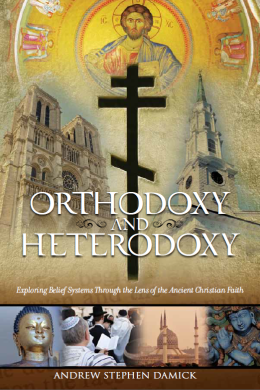
As the “Orthodoxy and Heterodoxy” podcast rolls on with publication on AFR (having been completed in “the real world” about a week and a half ago; all handouts are available here), I am receiving more and more email with regard to its contents. Most of the messages are just kind words of thanks, which are of course very nice to receive. Some few are outright denunciations, strongly worded. But then the bulk of the rest may be summarized by either or both of the following statements:
1. You did not cover my religious group with the sort of detail it deserves.2. You are wrong about my religious group’s teachings. We’re actually right.
Many such messages are also strongly influenced by the fact that the commenter has not listened to all the parts of the particular lecture in question (AFR is dividing them each up into two or three parts, which turns seven lectures into at least fifteen episodes), so they’re not actually getting everything I said in that whole lecture which might be pertinent to their group. Others comments are a permutation of that sampling error, based usually on the fact that the whole series hasn’t been aired yet—I have some rather detailed comments to say in general about all religions vis-à-vis Orthodoxy in both the first and the last lectures of the series. That’s particularly important, since I don’t intend my remarks to be taken outside the overall educational and evangelistic purpose of the talks. But of course I acknowledge that those are hazards of the format, so I just keep responding with “Be sure to listen to the other parts of the lecture” and “Be sure to listen to the first/last lecture.”
In any event, regarding the two primary objections noted above, I find myself in my replies frequently repeating several observations. Again, it’s understandable that people should have these objections, given the format—after all, by submitting them for AFR’s editing and publication, I am removing them from their original intended context and allowing them to be apprehended by a diverse population whose presuppositions and experiences are likely far different from the original.
So here’s what a bit of I’m repeating:
- 1. This lecture series is an “encyclopedia-level view” of the various groups in question, designed for parish education for people who are already Orthodox Christians. It is not meant in any sense to be a detailed examination of all the various permutations of each religious group covered (well over 100!). There is simply not enough time for that, given the design, and I rather doubt that the people attending the lectures would be interested, for instance, in an in-depth examination of Confessional Lutheranism or the less-hyper-than-hyper-Calvinists.
This was a particular problem in dealing with Roman Catholicism, to which I dedicated an entire lecture. What the Magisterium teaches is not identical to what Catholics are hearing in the pulpit and in confession, nor is it identical to the vast world of Roman Catholic theology which has, it must be admitted, somewhat revolutionized Catholic life over the past century. In many regards, the Magisterium is somewhat “lagging behind” all those trends (and good for them!), some of which are in my opinion worth pursuing (e.g., the Eucharistic ecclesiology of Henri de Lubac), while others are very much not (e.g., Liberation Theology). But who am I, as an Orthodox Christian priest, to try to sift through all that stuff and declare which versions are the “true” Roman Catholicism, over and above the sorts of official statements in the Catechism? Not going there; don’t have the time for it, anyway.
As a result of all this, I deliberately have simplified much of what I say about other faiths. No doubt many adherents would regard it as oversimplification, but I’ll at least say that I tried my best not to do that.
2. These lectures are not evangelistic in their immediate purpose. That is, they were designed for Orthodox Christians to learn about and begin to engage people of other faiths. One of their ultimate purposes, of course, is evangelistic, but only in terms of helping Orthodox people understand other faiths better so that they can enter into conversation with their adherents. The other purpose of these lectures is to educate Orthodox people better in their own faith, by means of comparison and contrast.
3. The series is deliberately non-ecumenical. Its purpose is not to enter into dialogue or debate, which I think is largely pointless on the “official” level but often fruitful on a personal level (see #2). This means that, for instance, when a member of one of the Reformed faiths tells me that his communion really was saying nothing new during the Reformation, just purging innovations accrued by Roman Catholicism, I am not going to agree with him. (If I did, I’d join their church!) The explicit purpose of these lectures is to present an Orthodox Christian view (note the “an,” not “the”) of these various faiths, which necessarily involves the use of critique, since Orthodox Christianity is not identical to any of the faiths being discussed.
Honestly, I would hope that serious members of these faiths would regard their own faith in the same way—if it’s really true, then that means that, where other faiths differ, then they must be false. I’m not sure how one can otherwise have any religious integrity.
In the past, I personally spent a lot of time debating with members of other religions, and I’m done with that now. So when I present a lecture on comparative theology, I deliberately favor Orthodoxy and make no pretense at being unbiased or neutral. I also make no claim to expert status on any of what I’m discussing. No one should be citing me in papers (though I just found out that a high school student at my home parish has done so!), and no one who is seriously interested in exploring any of these subjects should consider my little lecture series the last word on the matter. Go check out the handouts (each of which includes an appendix of sources) for further reading, and go beyond that.
Yesterday, my khourieh asked me if all this email was stressing me out. It’s not. I expected it, though I didn’t expect the volume that I’ve received (which has been manageable). I do find it fascinating, though, that so many of the responses can be sorted into the above two objections. I certainly didn’t expect that.
One of the reasons I talked with AFR about recording and publishing this series is that I think there is precious little being done along these lines. Very few Orthodox writers seem interested in doing work to help parishioners engage the theologies around them. Yet if we do not do this, we both risk losing people to these heterodox groups and we also cut the legs out from under many evangelistic possibilities. So I’ve thrown in my contributions. I hope others do far more detailed and better work than I.




“Very few Orthodox writers seem interested in doing work to help parishioners engage the theologies around them. Yet if we do not do this, we both risk losing people to these heterodox groups and we also cut the legs out from under many evangelistic possibilities.”
Amen and amen. I encountered this lack when I first began to investigate Orthodoxy just over 5 years ago.
And, I cannot help but think all the critical mail you’ve received is a good sign. … perhaps more folks are investigating their own roots.
father, i think all of the mail is a good sign. afterall, these folks are listening to your lectures via an orthodox website. they are coming for a reason.
Hi Father, You are running up against the same thing I ran up against when I took “Denominational Doctrines” at a church of Christ college. I look at my old textbook and the section on “Eastern Orthodox” and it is unrecognizable to me now, but if I’m honest it is our faith filtered through their lenses. People who respond to internet productions of any ilk, whether blogs, podcasts or websites are a thin slice of their expressions and are more apt to nitpick the nuances but they don’t realize that the nuances are a part of what makes the what they are: an ever more fragmented and nuanced and denominated expression of the true faith.
Fr:
Think sometimes and in some cases there are some things where the opposite occurs: the podcasts mentioned a few bones with the RC’s that are true in a popular Orthodox sense in this country, but really are based on misunderstanding of the Orthodox position and experience. Thought about writing you privately on this - but didn’t have your email, and at the end of the day… life’s too short to play policeman. And as you say, it does reflect the Encyclopedia view even if it made us look a little unbalanced.
“Misunderstanding” is of course very much a possibility, since I am not an expert, but whether that’s true or not depends on a number of things: Who is the one defining RC doctrine? And is it a misunderstanding to criticize and declare those doctrines to be wrong?
As an example of this, I was told by a current Catholic that the notion of “years” in Purgatory was only ever meant to be a sort of metaphor. Clearly, that Catholic had one understanding. But in the history of indulgences, which are traditionally so meticulously laid out in terms of units of linear time, it is quite tough to metaphorize the whole thing away. What would be the point of those elaborate charts detailing how many years of indulgences one gets for various behaviors if they’re really just a metaphor, anyway?
Anyway, thanks for your comments. In case you should ever wish to email me in the future, you can do so through my parish website.
I was directed to this series of podcasts by Dana Kees of Saint George parish here in Houston, Texas. I recently met Fr. John Salem at the barber shop in our neighborhood and through conversation learned about his parish, which I began attending that very week. Dana has been answering my many questions about the EOC as I consider the possibility of converting (coming home?) via Saint George parish. Dana thought I would this series especially helpful as someone who grew up Protestant and converted to Catholicism in young adulthood. And he was right, it has been very helpful. And exciting.
The feedback you’re getting about “you have all all wrong, because of course we’re right” is the direct result of the entire mindset of rationalist Christianity and is a big part of what I’m trying to escape from. There is very little one can do to combat this, since all your appeals will be to history and tradition, which these groups more or less entirely reject (albeit selectively, I’ve seen many Calvinists resort to St. Augustine to insist that anything less than Total Depravity amounts to Pelageanism).
So far, my only critique hasn’t been theological at all, but rather a critique about art history. Italian Renaissance art happened primarily outside the context of (and in many cases outside of the approval of) the Catholic church and its influence. Much of the influence for the Renaissance was actually neo-Classical and was, at least at first, highly objectionable to the RCC specifically -because- it was so “fleshy”. The famous images in the Sistine Chapel were scandalous at the time and the recent restoration work has exposed the fact that much of it had been subsequently censored by other artists on behalf of the Vatican.
Which does not, of course, negate your point that Catholicism (and Protestantism) is somewhat ironically obsessed with the physical. There is a great deal to support that claim. I would just suggest (humbly, of course) that Italian Renaissance art isn’t a particularly good example given that most such artists were living well outside Rome’s good graces and tended to be far more sympathetic to Dualistic Humanism.
A complete trifle, but as someone who studied art history as an undergraduate, it jumped out at me when you said it.
Jim,
Your point is well made and, I hope, as well taken.
My intention was not so much to make a specific doctrinal or ecclesiastical point there but rather to point out a different theological culture. While Italian Renaissance artists may not have been in the good graces of the Vatican, they and the Vatican were breathing the same cultural air, and of course, even though there may have been tension at the time, that sort of art is now widely accepted in Latin churches.
Orthodox artists flirted with that stuff (especially in the Orthodox North), but have ultimately rejected it. Our painters were never very good at it, anyway.
In any case, thank you for taking on this project.
I may be jumping ahead to episodes not yet aired, but I’m curious if you covered, or if not would you consider covering, the contemporary post-evangelical movement referred to by many as “emergent”? I spent some time talking to people in these circles and it is absolutely fascinating to realize that they -see- the problems with the embracing of Dualism (neo-Platonism and neo-Aristotelianism) and are even to some extent trying to look back to The East to find a solution to this problem, but their Protestant dedication to Sola Scriptura makes it impossible for them to genuinely consider a return to tradition. They are, perhaps, too new a phenomena to yet discuss from the outside looking in, but I was curious simply because I see so many there searching for what the EOC seems to have but unable to accept the very simple road back towards it.
I do cover the Emergents (in my decidedly inexpert way) in lecture #5, which should begin airing on AFR next week. As you say, though, it’s all too new and (if I may add) multifarious to say too much about the phenomenon.
I sometimes wish I could take a multi-month sabbatical to spend my Sunday mornings actually experiencing a lot of what I can only read about. But of course I would starve (in more ways than one) if I did that.
This may seem dismissive or discourteous, but in the case of the emergents, you aren’t missing very much. I spent almost four years trying to find a “cohort” to join that met on a regular basis across four different major US cities with no luck whatsoever. This is a phenomena that exists predominantly online. If you happen to live near Tony Jones or one of the other big players and so can attend their meetings, that’s one thing, but if not, you get to go to church on the internet. It has far less to do with “church” and far more to do with blogs and books.
I’ve been appreciating the podcasts, and came here today to give you a quick “thank you” for making them available, and found this thread waiting for me as an appropriate place to say it.
I’m from a Mennonite background (though my family is not historically Anabaptist), and was curious to see what you would say about them. Indeed, (1) you did not cover them in the detail it deserves, and (2) you were wrong in some of your descriptions. (Ha ha…)
Looking forward to future broadcasts…
Bill
Fr. Andrew,
I found this blog through the Ochlophobist, and I must say that I find your podcasts truly remarkable. It was most intriguing to find out what the other side had to say. As a born and raised Roman Catholic, my education touched upon the Eastern Orthodox Church only briefly. My encounter on this site (and at the Ochlophobist) are teaching me that there is a theology and tradition operating here that I cannot ignore.
I’m sure you have heard a great many objections already from Roman Catholics so I will not pelt you with more.
I did have one question: do you think Roman Catholics can be saved?
Yes, of course. I believe that every person can be saved.
Ah, thank you, Fr. Andrew. I have simply heard so many different permutations of extra ecclesia nulla salus, that I was unsure what the Orthodox believe. But perhaps you have not said everything on that matter?
No, not remotely!