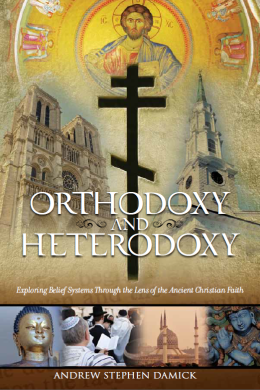
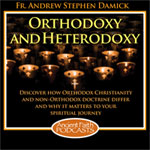
Roads from Emmaus is the personal weblog of the Rev. Fr. Andrew Stephen Damick, pastor of St. Paul Orthodox Christian Church of Emmaus, Pennsylvania, author of Orthodoxy and Heterodoxy: Exploring Belief Systems Through the Lens of the Ancient Christian Faith (available from Conciliar Press and via Amazon.com) and host of the Orthodoxy and Heterodoxy and Roads from Emmaus podcasts.
Orthodoxy and Heterodoxy turns one!
On Saturday, May 12, Orthodoxy and Heterodoxy: Exploring Belief Systems Through the Lens of the Ancient Christian Faith turned one year old!
It’s honestly a little hard to believe. This little path has now been winding about for more than three years.
O&H was originally done as a series of lectures offered at St. George Orthodox Cathedral in Charleston, West Virginia, beginning in November of 2008. At the time, I conceived of it as something of an exercise in encyclopedia-making, an attempt to catalogue nearly every religious movement in the world (especially Christian) and offer a brief summary of its similarities and differences with the Orthodox Church. I had no expectation that hardly anyone would actually attend the lectures, since I figured that relatively few folks would have an interest in such questions. The folks at the cathedral proved me very much wrong.
When I came to St. Paul Orthodox Church in Emmaus, Pennsylvania, in July of 2009, I wanted to offer some adult education classes that Fall, and since there were already so many other things happening connected with newly taking up the pastorate at a parish that made any major writing projects almost impossible, I figured I would pull O&H out of my files, give each talk some revision, and then deliver them again.
Before I actually delivered the talks, I ran into John Maddex, CEO of Conciliar Media (which includes both Conciliar Press and Ancient Faith Radio) at the Missions and Evangelism Conference at the Antiochian Village in September of 2009. I grew up as the son of radio missionaries, and with his extensive background in Christian radio, we found we had some things in common. He was even aware of who my father is, and it turned out that he had helped run a local Christian radio station in northern Ohio that I listened to as a kid.
In the course of our conversations, I mentioned my plans to deliver O&H here in Emmaus, and he and his wife Tonya both agreed that they would be interested in recordings of the lectures for Ancient Faith Radio. Not long after that, I received in the mail a box containing a microphone / mp3 recorder, something of a step of faith on their part, since they had never heard me speak or even read what I’d written!
That Fall, I recorded O&H in Emmaus. Turnout at those lectures was also quite good, filling our parish hall nearly to capacity. Soon after the recordings began, O&H started airing on AFR as a podcast. I also started getting a lot of email from listeners—some highly critical and even hostile, but mostly exceptionally kind and positive.
In late February of 2010, I got an email from the acquisitions editor at Conciliar Press, saying that John had asked her to contact me to see if I would be interested in making O&H into a book, that the podcasts had been so popular that they were convinced it would also do well in print. In all honesty, I was exceptionally surprised.
I had in my younger days imagined myself being a published writer, but eventually I put away that childish vanity and settled on the idea that blogging was pretty much going to be my only real publication. So when CP approached me with the proposal, it hardly seemed real. Nevertheless, within about 45 minutes of receiving the initial email from CP, I responded positively. How could I not?
I then entered the process of getting hierarchical approval for the publication and, once that was secured, began working on a complete overhaul of the original manuscripts. I reordered the chapters, did some renaming, corrected errors, nuanced some things that had been phrased too absolutely, and added some new material. I started out with lectures totaling about 60,000 words and ended with a book that was roughly 72,000 words. Along the way, CP did a lot of work to refine the editing and also produced the cover featured above. It went to press the following Spring, in 2011, and went on sale in May. The following November, it was made available as an e-book.
I have been honored and humbled by this whole process, and I am most especially immensely grateful to my wife who is a good check on my temptation to vanity. I’m grateful to John Maddex who put the resources of Conciliar Media behind this material twice and also to all the listeners to the podcasts and to the readers of the book.
If you haven’t yet bought a copy of the book, here are some places you can do so: Conciliar Press, Amazon.com, Amazon Kindle, and B&N NOOK.
You may already be aware that I also have another, ongoing podcast with other lectures (and recently, sermons) entitled Roads From Emmaus, and I’ve also signed a contract with CP for another book tentatively entitled An Introduction to God: Encountering the Divine in Orthodox Christianity which is in the revision process. We’ve also lately been discussing the possibility of a book of essays, as well.
Again, thank you for your prayers and support in all of these projects. I love doing them, and I hope they’re useful to you.
Children and the Cosmos
The following is a repost from September of 2008, when our first child (now 5, the older one you see in this photo) was only 18 months old. Since my wife just gave birth to our third child (also pictured) on Monday—a boy named Raphael Joseph Caedmon—I thought it apt.
Children and saints cling to You, O Lord, the rest rebel against You.
Children and saints are the boundary between the Kingdom of existence and the shadow of nonexistence.
—St. Nikolai Velimiromich, Prayers by the Lake XCV (full passage here)
It occurred to me recently in becoming a father that I am even less of an atheist than I was before. (This is predicated upon the truth that we are all atheists to one degree or another—the only truly perfected believers are the saints.) This quote above from St. Nikolai which I ran across this morning alludes directly to this thought that I had sometime last week.
In looking at a little child, most especially one’s own, we are enabled to become acutely aware of the awesome reality of creation. Here is this person who until recently was defined only by non-being. Before her conception, my daughter simply was not. To be sure, there were cells and proteins and molecules and atoms which would go into her constitution. But they were not my daughter.
And then, into the nothingness, God stepped once again and called her forth ex nihilo, just as He did the universe itself. It is only with the eyes of faith that one can even begin to perceive this boundary between the total non-being of a person and the sudden, yet secret and mysterious, truth of personal existence.
Here, before us, is this new person, created by God in the hidden and sacred interior of womanhood and then revealed to the world in due time. She is unrepeatable, unique, a singular event in history which has never before been seen and never will be seen again.
And this is the same power which Christ holds out to each of us for our re-creation, that having hurled ourselves toward the nothingness from which He called us, we may repent (turn around) and be renewed in that same life-giving energy and power.
How the heck can we ever allow ourselves to become nominalists? We can only stand in rapt wonder.
Church History and Same-Sex Marriage
There have been several postings online in the past few days of various articles claiming that the Christian Church at some period in history formerly sanctioned same-sex weddings and treated them just like marriages between a single man and a single woman, based mainly on the work of the late John Boswell. Someone even posted one of those articles in the comments section of my previous post. The one making the most rounds is called When Same-Sex Marriage Was a Christian Rite. These articles are served up as “gotchas” to unsuspecting Christians who were under the impression that Christian history is pretty unanimous about what Christian marriage is about. (Spoiler: Their impression is correct.)
Mind you, someone may reject the Church’s historic teaching on marriage. But there really are no legs to stand on when it comes to the claim that the Church used to teach that marriage could also be between two men or two women (or any other combination). (And note here that I mean the historic Church, which is Orthodoxy. But this would also include almost all churches that are more than about 100 years old.)
Anyway, there are numerous articles which thoroughly debunk Boswell’s work. His fellow historians didn’t take it seriously, and neither should you. The only people who do (and I really am not making this up) are those who either don’t know better or quite desperately want him to be right. Boswell himself was gay and the founder of the Lesbian and Gay Studies Center at Yale. He died of AIDS-related complications in 1994 at the age of 47. He was also a convert to Roman Catholicism from the Episcopal Church (despite his much greater similarity with the latter on sexual morality).
Anyway, the point of this post is not to invite debate (because for me, the matter really is settled, and there are a quadra-gazillion other places to debate these questions; as such, I am not turning on comments for this post), but rather to point out some of the several places online where one can read refutations of Boswell’s work, far better than anything I could put together. The slams, as they say, are dunked.
- In the Case of John Boswell by Fr. Richard John Neuhaus (a Catholic convert from Lutheranism) examines the scholarly reception of Boswell’s work.
- Gay Marriage: Reimaging Church History by Robin Darling Young is a detailed examination especially of the numerous specious translations in Boswell’s work (upon which his conclusions very much hang). Interesting in this piece is especially the reminiscence that its author experienced a same-sex union in an ancient church and was surprised to be told later by Boswell’s book that what she had experienced was actually a marriage. This is the first piece I ever read on this subject, and it packs a powerful punch.
- Failed Attempt to Rewrite History by Fr. Patrick Viscuso is an examination specifically of the canonical and liturgical claims that Boswell makes and how they fail to square with the actual contexts of the rites being examined. Viscuso is a priest of the Greek Orthodox Church and a canonist specializing especially in marriage questions. He is also cited(!) in Boswell’s work.
- Rewriting History to Serve the Gay Agenda by Marian Therese Horvat is a general review of Boswell’s Same-Sex Unions in Premodern Europe, especially focusing on what the author calls Boswell’s “advocacy scholarship.”
- A Groom of One’s Own? by Brent D. Shaw shows how anachronistic and tendentious Boswell’s readings of documents are. Shaw is himself in favor of the “liberationist movements of our time,” but he concludes that “tinkering with the moral balance of the past is a disservice to the study of history and to the reform of society.”
- Procrustean Marriage Beds by Robert Louis Wilken can best be summed up by its last two sentences: “Same-Sex Unions in Premodern Europe creates a world that never existed, misrepresents Christian practice, and distorts the past. This is a book on a mission, scholarship at the service of social reform, historical learning yoked to a cause, a tract in the cultural wars, and it is in that spirit that it should be read.” Wilken is one of the most respected patrologists of our time.
- Do you take this man… by David Wright shows how Boswell’s Same Sex Unions is essentially a rehashing of his earlier work that fails to take into accounts the criticisms the earlier one drew.
- Remarks to the Catholic Press by Fr. Robert Taft is not really a review but just some blunt offhand remarks by one of the most respected Jesuit liturgiologists of all time. (Warning: Do not read this out loud to children!)
- Archimandrite Ephrem Lash, the famed liturgical translator from the UK also did a review of Boswell’s work for the journal Sourozh for its February 1995 issue, but it doesn’t appear to be online. There are bits of it quoted in the Wikipedia article on Adelphopoiesis (“brother-making”), the rite Boswell claims was a same-sex marriage.
I would be remiss if I didn’t note that I found some of these links at the excellent Mystagogy weblog’s recent post on this subject.
If readers find other pieces offering up similar debunkings, feel free to send me the links, and I’ll add them here.
Again, just to be clear: I don’t hate homosexuals or people whose politics would have homosexual marriage enshrined and enforced as a civil right by the state. I also don’t hate people who reject Orthodox Christian teaching. The point of this post is to point you to some information debunking the claim that the Church has not always taught that same-sex attraction is a temptation like any other temptation (note I didn’t say “worse than all other temptations”) that has to be struggled against and repented of when indulged. I also do not believe that acting on that temptation is a worse sin than any of my own sins.
Oh, and this bit is pretty good when it comes to laying out a clear sense of what it means to be a Christian who believes in traditional Christian morality and isn’t going around hating people who don’t or who fail to live up to what they do believe in.

The Scarlet Letter, by T. H. Matteson
Update: This post is now available as an audio recording at Ancient Faith Radio.
Gradually it was disclosed to me that the line separating good and evil passes not through states, nor between classes, nor between political parties either, but right through every human heart, and through all human hearts. This line shifts. Inside us, it oscillates with the years. Even within hearts overwhelmed by evil, one small bridgehead of good is retained; and even in the best of all hearts, there remains a small corner of evil. —Alexander Solzhenitsyn, “The Gulag Archipelago”
“Aren’t you supposed to hate me?”
That was the question once asked me by a homosexual friend and co-worker, back during my stagehand days (1994-2004), when she learned that I was an Orthodox Christian.
I thought about that moment again today while I watched my North Carolina friends posting online about North Carolina’s Constitutional Amendment One, which in a vote yesterday enshrined into the state’s constitution a legal definition for marriage as between one man and one woman. I lived in the Raleigh, North Carolina, area for eleven years, and from what I could tell, most of my friends there who are active online were very much against the amendment. In fact, I don’t think any of them were in favor of it. Nevertheless, it passed a popular vote with 61% approval.
What really struck me today was that several posters (who normally are not very interested in religious things) declared that anyone who voted in favor of the amendment was not a real Christian. It was kind of surreal to see some of these people making such religious statements when they never seemed to pay any particular attention to Christian doctrine before. Their statements seemed to be based on this syllogism: Voting for the amendment means you hate gay people. Jesus is loving. Therefore, if you voted for the amendment you are no real Christian. (Update: Did you catch that? These are pro-same-sex marriage folks who wanted others to oppose a piece of legislation for religious reasons.)
There were other variations on this claim, though usually without bringing Christ into it. The consensus seems to be that voting for this amendment means that the voter hates gay people (or others who may be affected). It does not seem in any way admissible that a loving person could ever vote for such a thing. One poster even said he simply could not fathom the logic that supporters were using when they voted.
In the course of related discussions, I was actually told by an old friend who (being convinced I would have voted for this particular amendment) essentially said that I believe what I do because my religion tells me I have to and that logic is always opposed to faith. There is of course a long and complex history of the interaction of faith and reason; some communions even go so far as to enshrine reason as a doctrinal pillar, but hardly any religions have ever actually rejected reason as being contradictory to faith.
Likewise, there is another problem with this assumption, namely, that I am actually someone who has chosen his faith and was by no means forced into it. Even had I been raised Orthodox, however, I would have to make a conscious choice to remain in the Church and faithful to its teachings. Come to think of it, I still have to do that. Even aside from simply the basic dynamics of trying to be a faithful Christian, it’s not like the world around me is exactly hip to Orthodoxy. The Church has always been counter-cultural.
Of course, on the other side of these things is the “GOD HATES FAGS” crowd, who actually have fairly little influence on anyone at all, but, if their ideological opposites are to be believed, somehow are identical to everyone who doesn’t all-out support homosexual activity. Still, I’m sure that there are folks who have traditional beliefs about the moral value of homosexual activity who do indeed regard gays as being damnably subhuman.
I also saw one post from an opponent of the amendment telling supporters to “go die in a fire.” Another one claimed supporters used only “weak” arguments from politics and religion and were therefore “fanatics” and “terrorists.” The first poster didn’t surprise me much, since he is given to that kind of language, but the second really did surprise me. (He was also one who said that supporters cannot be real Christians. That surprised me, too, because he’s not ever been, to my knowledge, remotely interested in church or even Christian “spirituality.”)
There seems to be little room here for the idea that someone can disagree, that they can even support unfavored laws, and still love the other. I think there is a little bit of the childish “You hate me, Mom and Dad” attitude here, chafing against anyone who won’t sanction a given behavior, but I believe overall it’s something much deeper, something actually theological, a vision of human nature.
In this view of human nature is also a reading of human history that admits of nothing but the progressivist narrative. “Social progress” always moves in one direction, and of course people who disagree with such “progress” are “on the wrong side of history,” etc. Never mind that history shows all sorts of “progressions” that such folks would find abhorrent. History sometimes moves in some pretty awful directions. And sometimes it even appears to “reverse” course, revealing what seemed to be an inexorable march toward progressive paradise actually to be a temporary anomaly. To one a certain thing is progress, while to another it may be regress, digress or even ingress. And of course everyone but me is wrong.
What’s underneath all of this is an assumption about human nature that almost never comes to the fore. It is essentially assumed that human beings are absolute objects incapable of actual dynamism and change. Reprobates can only be eliminated through force, whether of violence or of law (which always implies a threat of violence). That is, what is assumed is a theological anthropology, and it is the anthropology of Calvinism.
We Americans are hardly ever more Calvinistic and puritanical than when we are at politics. I observe this not about any particular political ideology or party, but about them all.
It is no wonder, of course. America was founded by such people. Calvinist anthropology is deep in our cultural DNA, and it is perhaps most prevalent in those who reject Christianity entirely. Their political opponents are “unloving,” “evil,” “hateful,” etc. There is little attempt actually to convince others of the rightness of their positions, only the assertion that opposing them makes the opponent a terrible person. You must hate me if you do not agree with me.
But “You hate me” is probably the silliest argument there is. It not only presumes a knowledge of someone else’s inner psychological state that is impossible, but it also is a defeatist attitude and presumes that one’s opponents are beyond redemption—and one’s own position is naturally what constitutes redemption.
In a world where everyone knows he’s a sinner and is actively working to repent, one can never have much ground to assume that one’s fellow sinners are “hateful,” etc. But in a world where I am perfect and right, of course anyone who disagrees with me is “hateful.”
When my gay friend asked me whether I was required to hate her, I told her no. She asked me why. I told her it’s because, even though I see homosexual activity (though not identity) as sinful, I believed my own sins were far worse than hers. It’s true. I really do. And I am (by choice) bound by my faith commitments to believe that, to see myself as the “chief of sinners.” I confess that every time I am about to engage in the most central act of my faith—receiving Holy Communion.
I do not in any sense believe that I am better than someone else just because the set of temptations I have and those I succumb to are different from someone else’s. How can I hate someone else for his sins or his temptations? I have so many of my own.
To be honest, I don’t really know how I would have voted on North Carolina’s Amendment One. I haven’t lived there for eight years now, so I’m not really a part of its life any more. I do know that I think the state should get out of licensing marriages entirely, if only because it almost inevitably leads to problems like this.
I do not believe that every sin should be illegal, and homosexual activity is one I do not think needs to be illegal. (And certainly one cannot criminalize feelings, either.) Yes, I do regard these things as symptomatic of a fallen humanity, but I don’t think that anyone’s salvation is furthered by criminalization.
I do, however, have a very serious concern about enshrining things at odds with religious communities’ doctrine as “civil rights,” because of what that does to religious liberty, a civil right long guaranteed under the U.S. Constitution. Once something is a civil right, then those who refuse to grant that right and not to hinder it in any way are subject to legal action—there have already been people successfully sued for not going along with gay weddings due to the dictates of their consciences, people who were minding their own business and just didn’t want to be a part of it.
I do hope that my friends can understand that I in no way hate them if I disagree with their politics or even with their personal moral choices. If I hated everyone who disagreed with me or who sinned, I would pretty much not have anything else to do with my time. But I’m a sinner, too, and my sins are far greater than theirs.
Over the years, I’ve had a number of friends, co-workers and parishioners who have identified as gay. To be quite honest, none of them ever seemed to be under the impression that I hated them. I don’t think it’s because I have any great virtue, but simply because I just didn’t hate them. I don’t understand why that possibility seems to elude so many.
For anyone who is not an Orthodox Christian or who does not subscribe in some way to the broad outlines of Christian moral tradition as it has generally been held without much real disagreement for centuries, I cannot of course expect that they will see themselves as sinners or that any particular action is a sin. If they don’t even believe in any transcendent divinity, then there is no reason to believe that there should be a transcendent “right” to which we are all responsible. I get that.
At the same time, however, I think it’s worth closely examining one’s presuppositions about such things as the nature of human persons, whether they can change, whether they have inherent worth, and whether it is actually possible to disagree without being consigned to the oblivion of the “hateful” category.
This kind of politics—the politics of hatefulness—comes out of a real theology. In this theology, there are only the elect and the reprobate—the damned.
Wouldn’t it be better to see others in a far more complex and (dare I ask it?) hopeful light? And let us especially remember the words quoted above from Solzhenitsyn: “Gradually it was disclosed to me that the line separating good and evil passes not through states, nor between classes, nor between political parties either, but right through every human heart, and through all human hearts. This line shifts. Inside us, it oscillates with the years. Even within hearts overwhelmed by evil, one small bridgehead of good is retained; and even in the best of all hearts, there remains a small corner of evil.”

Addendum: I liked this comment from Fr. Stephen so much that I’m reproducing it here in the body of the post. Some of the responses to it are quite interesting, as well.
I think the root of the issue you’re identifying goes much deeper than just Calvin’s anthropology. All of Western Christian thought since St. Augustine (obviously including Calvin) has been Platonist thought, to one degree or another. Even Thomas Aquinas (whose grand project was to try to reconcile the newly discovered Aristotelian science the pre-existing Platonist Christianity he had inherited, over against the Latin Averroists like Siger de Brabant who were ready to discard the latter), as revealed in Book I of the Summa and his eschatology.
Why that’s important is this: One of the fundamental principles in Platonist thought is that distinction implies opposition. Unity, or ‘One-ness’ is a good, and therefore to be truly Good, anything must be One. So, for example, there can only be one correct interpretation of any given passage of Holy Scripture. All other interpretations are not just somehow faulty or incomplete, but are actually opposed to the correct interpretation and seek to subvert it. All of those other interpretations aren’t ‘nice tries’ or ‘alternate takes’ or ‘other applications in different contexts’, they’re sinful attempts to undermine the One Truth.
This results in this horrible confusion of epistemology and ethics, in which ignorance of certain facts, or differing beliefs, even if held with no ill will or ulterior motive, are still treated as sin, as evil acts. Therefore, if I hold that ‘x’ behavior is morally wrong, and you hold that it is morally right, our views aren’t just alternatives to each other, they actively oppose each other, and we ‘have to’ at the minimum, hate each other’s views. Neither God, nor you and I, can just live sinners, we have to somehow at the same time hate their sin. It can’t be overlooked, passed over in respectful silence, or ignored.
Orthodoxy, Allegory and Fantasy

The Last Homely House, by J. R. R. Tolkien
Fantasy remains a human right: we make in our measure and in our derivative mode, because we are made: and not only made, but made in the image and likeness of a Maker. —J. R. R. Tolkien, “On Fairy Stories”
There is a new post today on MyOCN‘s “Orthodox Writers, Readers, and Artists series,” whose title caught my eye: Is it Orthodox to Read and Write Allegory/Fantasy Children’s Books?
Friends and long-time readers will imagine that my hackles immediately went up when I read this. Of course, I’ve encountered the attitude in this piece before. I once spoke, for instance, with an Orthodox Christian who was putting together a homeschooling curriculum. He insisted that imaginative fiction of every kind was essentially sinful, that it was phantasia—a word used in monastic literature (and sometimes spelled phantasy or fantasy) to refer to sinful imaginations. This is essentially the same attitude that, when intensified, will condemn Tolkien and Lewis as pagan sympathizers (not to mention those bewitching Harry Potter novels!).
To be quite frank, I think this attitude is puritanical nonsense. I don’t blame those who hold it, though I do believe that they have mistaken the phantasia that the monastic fathers warned against for the fantasy that is imaginative fiction. (I will from here on use those two spellings to make that distinction.) That is, they have turned a specific piece of monastic technical language regarding meditative prayer into a general principle—a literary theory, even—to exclude something that those monastic writers weren’t remotely talking about.
Phantasia is a danger in ascetical writings not because it uses the imagination. Rather, it is a use of the imagination that fixates the heart on created things. More specifically, it is a fixation that is an obstacle to the pure prayer of the heart. In pursuing meditative prayer, the ascetic (who is not just the monastic, but all of us) is called upon not to try to imagine God, to picture Him, or to become obsessed with any created image in order to reach Him, because doing so is essentially idolatry. It is also simply prejudicial, just like relating to any human person by means of imagination rather than through encounter.
But fantasy (even the specific literary genre that goes by that name) isn’t about prejudicial obsessions with created things that block us off from God. If imagination qua imagination were only phantasia in the sense that the monastic fathers warn us of, then many of the great Fathers of the Church would be in rather deep trouble, for a good many of them had rather thorough educations in fiction—even in explicitly pagan literature. No less a luminary than St. Basil the Great admonished the young on how exactly they ought to make use of pagan literature! No puritan he, Basil taught his readers how to sift what they read, how to find the face of Christ even in works specifically designed to promote religion that the Church was in the process of conquering.
Now, the writer of the piece linked above does not quite seem to have it in for all fiction (being a writer of children’s books), but I am unclear on what basis the argument against fantasy is being made if it is not simply that it is to be identified with phantasia. After all, if the problem with fantasy is that it is “whatever the mind imagines end[ing] up on paper,” then that would apply to all fiction. (But what writer actually just writes “whatever” his mind imagines? Any writer worth his salt—or, you know, magic fairy dust—sifts, revises, etc.) But the exit from this charge for the writer seems to be through allegory, because allegory is the specific use of fictional imagery to attempt to teach something.
Because of this, the writer lets Tolkien and Lewis off, because they are supposedly allegorists and because they still lived in a time when “little ‘o’ orthodoxy was still pretty free from relativism, so what they are teaching is, at least for the most part, not contrary to Orthodoxy.” Aside from the fact that “little ‘o’ orthodoxy” by definition is free from relativism (no relativist would claim to be orthodox, even with the little “O”), this again misses the basic point.
But first, let us tackle the writer’s accusation against fantasy, that it is “a pure expression of the passions,” that it contains “werewolves and vampires and a celebration of evil,” that it consists of “a lustful voyeurism so that people constantly want more and more perverse and graphic fantasies.” Yes, one can certainly find such things out there, and I think I may know what the writer has in mind with the tip of the cards offered later: “modern fantasy generally has some sort of romantic involvement of the characters,” one that is properly “described as downright pornographic.”
No doubt it is Twilight (which happens to be written by a devout Mormon) and its ilk that is in mind here. But really, aren’t such things really just “romance” novels that have only the most superficial resemblance to the fantasy genre, which is populated with writers the likes of Tolkien, Lewis, Eddings, Brooks, Jordan, Salvatore, McCaffrey, Kurtz, etc.? I don’t know whether the writer has read much of the works of the big names in “modern fantasy,” but I’m really starting to suspect not. I think what the writer really doesn’t like is romance novels with werewolves and vampires. If that is really the case, why condemn a whole (barely related) genre?
But let us return to allegory.
It is true that Lewis was fairly self-consciously allegorical, but only with a certain minority of elements in his works. True allegory would have every rock, tree, beast and boy as a stand-in for some other person or lesson. Lewis doesn’t quite do that.
However, the far more masterful storyteller of the two, Tolkien, was vehemently explicit about his rejection of allegory, something made plain in his foreword to The Lord of the Rings:
I should like to say something here with reference to the many opinions or guesses that I have received or have read concerning the motives and meaning of the tale. The prime motive was the desire of a tale-teller to try his hand at a really long story that would hold the attention of readers, amuse them, delight them, and at times maybe excite them or deeply move them…. As for any inner meaning or ‘message’, it has in the intention of the author none. It is neither allegorical nor topical…. I cordially dislike allegory in all its manifestations, and always have done so since I grew old and wary enough to detect its presence. I much prefer history, true or feigned, with its varied applicability to the thought and experience of readers. I think that many confuse ‘applicability’ with ‘allegory’; but the one resides in the freedom of the reader, and the other in the purposed domination of the author.
It seems to me that the columnist would indeed prefer the “purposed domination of the author,” that the only good fiction is allegorical fiction, but it had better be trying to teach some sort of Christian lesson, “trying to get a person who has been spiritually deadened by this world, and everything in it, to see clearly spiritual principles using imagery that is not familiar to the person,” to get them to see “new worlds with new creatures that have not been co-opted by evil.”
But I am not interested in reading a book where everyone is perfectly happy and good, not “co-opted by evil.” Why? Because such a book would not speak to the reality in which I actually find myself, in which nearly everything around me—including me!—has been co-opted by evil. (To be honest, though, since when have vampires and werewolves ever not been “co-opted by evil”? Twilight‘s mistake is probably that it is attempting to co-opt such evil images as good.) Even the Scriptures themselves are rife with people and things co-opted by evil. And their point is redemption, just as it also is with good writers of fiction, whether they are being explicitly allegorical or not.
This rejection of fantasy as phantasia (accompanied by all of phantasia‘s ills as apparently exemplified by the romance novels with blood and fur and such) is really a denial of the Orthodox anthropology of man as being made according to God’s image. He is our Creator, and as such, we may (to use Tolkien’s language) become sub-creators. We are not merely imitators or allegorists. Such a veiled didacticism will hardly reach anyone these days, anyway. The moment a reader suspects he is being taught a lesson, that the author is “trying to get a person who has been spiritually deadened by this world, and everything in it, to see clearly spiritual principles,” he will reject the story.
I think we can do no better than some of these meditations from Tolkien’s brilliant reflection on such things, On Fairy Stories:
When we can take green from grass, blue from heaven, and red from blood, we have already an enchanter’s power—upon one plane; and the desire to wield that power in the world external to our minds awakes. It does not follow that we shall use that power well upon any plane. We may put a deadly green upon a man’s face and produce a horror; we may make the rare and terrible blue moon to shine; or we may cause woods to spring with silver leaves and rams to wear fleeces of gold, and put hot fire into the belly of the cold worm. But in such “fantasy,” as it is called, new form is made; Faerie begins; Man becomes a sub-creator.
An essential power of Faerie is thus the power of making immediately effective by the will the visions of “fantasy.” Not all are beautiful or even wholesome, not at any rate the fantasies of fallen Man. And he has stained the elves who have this power (in verity or fable) with his own stain. This aspect of “mythology” —sub-creation, rather than either representation or symbolic interpretation of the beauties and terrors of the world—is, I think, too little considered. Is that because it is seen rather in Faerie than upon Olympus? Because it is thought to belong to the “lower mythology” rather than to the “higher”?…
Children are capable, of course, of literary belief, when the story-maker’s art is good enough to produce it. That state of mind has been called “willing suspension of disbelief.” But this does not seem to me a good description of what happens. What really happens is that the story-maker proves a successful “sub-creator.” He makes a Secondary World which your mind can enter. Inside it, what he relates is “true”: it accords with the laws of that world. You therefore believe it, while you are, as it were, inside. The moment disbelief arises, the spell is broken; the magic, or rather art, has failed….
But the error or malice, engendered by disquiet and consequent dislike, is not the only cause of this confusion. Fantasy has also an essential drawback: it is difficult to achieve. Fantasy may be, as I think, not less but more sub-creative; but at any rate it is found in practice that “the inner consistency of reality” is more difficult to produce, the more unlike are the images and the rearrangements of primary material to the actual arrangements of the Primary World. It is easier to produce this kind of “reality” with more “sober” material. Fantasy thus, too often, remains undeveloped; it is and has been used frivolously, or only half-seriously, or merely for decoration: it remains merely “fanciful.” Anyone inheriting the fantastic device of human language can say the green sun. Many can then imagine or picture it. But that is not enough—though it may already be a more potent thing than many a “thumbnail sketch” or “transcript of life” that receives literary praise.
To make a Secondary World inside which the green sun will be credible, commanding Secondary Belief, will probably require labour and thought, and will certainly demand a special skill, a kind of elvish craft. Few attempt such difficult tasks. But when they are attempted and in any degree accomplished then we have a rare achievement of Art: indeed narrative art, story-making in its primary and most potent mode….
Fantasy is a natural human activity. It certainly does not destroy or even insult Reason; and it does not either blunt the appetite for, nor obscure the perception of, scientific verity. On the contrary. The keener and the clearer is the reason, the better fantasy will it make. If men were ever in a state in which they did not want to know or could not perceive truth (facts or evidence), then Fantasy would languish until they were cured. If they ever get into that state (it would not seem at all impossible), Fantasy will perish, and become Morbid Delusion.
For creative Fantasy is founded upon the hard recognition that things are so in the world as it appears under the sun; on a recognition of fact, but not a slavery to it. So upon logic was founded the nonsense that displays itself in the tales and rhymes of Lewis Carroll. If men really could not distinguish between frogs and men, fairy-stories about frog-kings would not have arisen.
Fantasy can, of course, be carried to excess. It can be ill done. It can be put to evil uses. It may even delude the minds out of which it came. But of what human thing in this fallen world is that not true? Men have conceived not only of elves, but they have imagined gods, and worshipped them, even worshipped those most deformed by their authors’ own evil. But they have made false gods out of other materials: their notions, their banners, their monies; even their sciences and their social and economic theories have demanded human sacrifice. Abusus non tollit usum. Fantasy remains a human right: we make in our measure and in our derivative mode, because we are made: and not only made, but made in the image and likeness of a Maker.
In the end, I have to confess that what I think I read in the column linked above was really a distaste for romance novels in the guise of fantasy, with the objection framed in language from the Fathers that was never intended to refer simply to imaginative fiction, whether it happens to have werewolves or not. But the objections to such things were on all the wrong grounds. Those grounds were made to serve other arguments and contexts. The problem with the “fantasy” disliked by the writer is not that it is not Christian allegory, or simply that it is fantasy, but rather that it glorifies that which is base. True fantasy instead redeems that which is base and thereupon reveals its glory.
Addendum: Something that occurs to me to add here is that, unless a publication is explicitly about theology, Church history, saints’ lives, etc., I think it does something of a disservice to the work to put an “ORTHODOX™” label on it. The last thing we Orthodox need is to create our own brand. Orthodoxy is not a brand. It is the Body of Christ. There is no need for us to put out a line of ORTHODOX™-approved books, toys, clothing, etc. (And we’d look dumb doing it.)
The Mass Cult of Big
The following is essentially a piecing together of selections from a Facebook thread in which I participated today. The following quotation led off the discussion:
We have become fascinated by the idea of bigness, and we are quite convinced that if we can only ‘stage’ something really big before the world, we will shake it, and produce a mighty religious awakening. - D. Martin Lloyd-Jones, 1958
This response was given by a poster:
“Doing something big, for bigness sake is silly and egocentric… however we shouldn’t fear something becoming something big…”
This was followed by a back-and-forth discussion. Here are my responses, more or less, stitched together and revised a bit:
I don’t fear big. But I am deeply suspicious of it.
Why? “Big” almost always means systems and ideology, but rarely attention to persons. It is typically about marketing, not about communion. It almost always means vanity (though usually is not advanced enough for real pride), but almost never any humility. It is usually about control and not about freedom. That’s why.
I am not talking only about church size, but about more than that, i.e., philosophy, politics, economy, architecture, education, etc. But even if we were talking solely about church size, a church designed to be big is automatically subject to all those problems. It is so prevalent one could almost assume that it’s written down in some sort of mega-church mega-manual. But such things are by no means prevalent on the much smaller scale. Why? Because human beings can only truly know so many people. After one’s communal capabilities are saturated, the only way to maintain things is through ideological and technocratic systems. Even the mega-churches at least sense this, which is why they do “small groups” to try to offset their technocratic leviathan.
Yes, some little church communities do indeed exert a kind of control over members, but that is rather the sectarian/cultic impulse, which is not really about the question of big/small or systematic/local, but rather of fierce personal loyalties. The fact that a mega-church cannot command such loyalties is precisely because of its inherent weakness—it is not about incarnational communion, but about marketed, corporatized consumption. Loyalty is created to a product, to programmes (which are a kind of product), not to persons.
If a mega-church is less susceptible to cultic-style control, it is essentially because it is a corporate entity that does not and cannot care. But it exerts a far more subtle and pernicious kind of control over its clients. It is one vast system, and if the mice wandering around in the maze do not realize they are in a maze, so much the better! The control here is essentially the control of the consumerist market, keeping consumers trapped in their own passions and desires. The rules it enforces are the demands of ideology and system—why do you think mega-churches need so many signs, ushers, automated check-ins for kids, etc.?
At least a little cult-like religious community still maintains the clear sense for its members that it is a set-apart elect. Members can more easily leave such a group, because all the control is usually focused into one or two people, and members may more easily have full social networks that are not comprised by the sect. And at least there is the possibility for repentance of the leadership. In a mega-church, if one head of the hydra is cut off, no one particularly questions the whole system. They just find another head to run the monster.
Loyalty should be only to Christ, not to personalities or religious products or programmes.
Yet “big” tends to lead in such directions almost without fail. “Small” actually quite rarely does. Very few small churches are cults of personality. But big ones quite often are, and they are more often (and sometimes simultaneously) cults of religious product.
It is telling that, in the early years of the Church, when congregations started becoming large enough that not everyone in the same city could easily join together for worship, the bishops began delegating their authority to presbyters to lead spin-off congregations.
And then when the faith was finally legalized in the early 4th c., there wasn’t a sudden move to building gigantic church buildings so that the full Christian population of cities could recombine.
The general rule was always small and local, even when necessity did not require it. It was because of a theology of the Incarnation and the communion that it creates, something that simply cannot scale up indefinitely, because of the God-made limitations of human personhood.
A desire to scale up indefinitely is indicative of a defective theology of the Incarnation, usually one that is devoid of any ecclesiology. Church is conceived of not as communion, but as rock concert.
It is true, of course, that some 3,000 people were baptized into Christ on Pentecost. That’s actually a fascinating and telling example, though—the Apostles were clearly perfectly capable of attracting a mass “rally” of sorts, but there’s only one example of such a thing ever happening. This exception proves the rule.
It is one of the great (at least linguistic) ironies of modern American Christianity that it has become a mass religion—a massive religion about masses of people, but without any hint of the mass.
Ite, missa est.