Month: January 2013
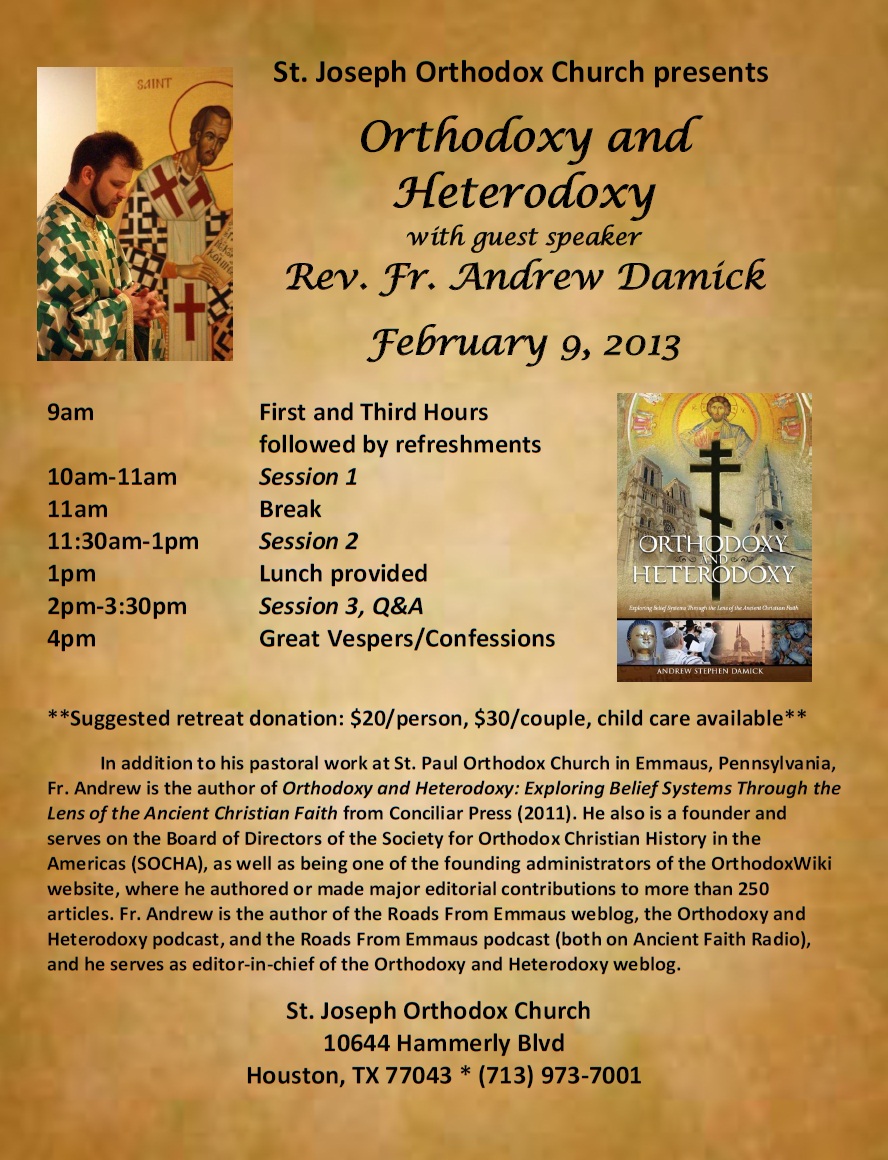
“Orthodoxy & Heterodoxy” in Houston, Feb. 9, 2013
I will be at St. Joseph Orthodox Church in Houston, Texas, on February 9, 2013, leading an “Orthodoxy and Heterodoxy” themed retreat. It would be lovely to meet many of you there. Copies of Orthodoxy and Heterodoxy will be on hand for purchasing and signing, should you so desire.
Share this:

The Tolkien Legacy

It’s a rare, if not exceptional, case. In an era where most people would sell their souls to be talked about, Christopher Tolkien has not expressed himself in the media for 40 years. No interviews, no announcements, no meetings — nothing.
It was a decision he made at the death of his father, John Ronald Reuel Tolkien (1892-1973), British author of the hugely famous Lord of the Rings (three volumes published in 1954 and 1955), and one of the world’s most-read writers, with some 150 million books sold and translations into 60 languages.
Was this long-held public silence simply a whim? Certainly not. The 87-year-old son of the great J.R.R. Tolkien is the calmest man imaginable. A distinguished Englishman with quite an upper class accent, who settled in the south of France in 1975 with his wife Baillie and their two children. Has he kept mum because he does not care? Even less likely. During all these years of silence, his life has been one of incessant, driven, almost Herculean work on the unpublished part of his father’s oeuvre, of which he is the literary executor.
The “money quote” that’s been going around from this first interview ever by Christopher Tolkien, his father’s literary executor, is this one, which lends the article its title (“My Father’s “Eviscerated” Work - Son Of Hobbit Scribe J.R.R. Tolkien Finally Speaks Out”):
Invited to meet Peter Jackson, the Tolkien family preferred not to. Why? “They eviscerated the book by making it an action movie for young people aged 15 to 25,” Christopher says regretfully. “And it seems that The Hobbit will be the same kind of film.”
This divorce has been systematically driven by the logic of Hollywood. “Tolkien has become a monster, devoured by his own popularity and absorbed into the absurdity of our time,” Christopher Tolkien observes sadly. “The chasm between the beauty and seriousness of the work, and what it has become, has overwhelmed me. The commercialization has reduced the aesthetic and philosophical impact of the creation to nothing. There is only one solution for me: to turn my head away.”
The headline is somewhat misleading, since the bulk of the article is really just about the enormous place of Christopher Tolkien in his father’s legacy. That said, I can appreciate his family’s unhappiness with the popularization of that legacy in film, though my own sense of it is that it has served to introduce more folks to the “real” thing in the canonical Tolkien works. After all, there have been mondo-gigantic boosts to book sales following the release of the films. More people are reading Tolkien than ever. And that is an encouraging thought.
Read the whole thing.
Share this:
What Does “Orthodoxy” Mean?
The following is an excerpt from the beginning of one of my lectures that I’ve also posted on my parish website.
It is well-known among Orthodox Christians that the word orthodoxy—often used as a shorthand for our faith—has two parallel meanings. It is composed of two Greek words—orthos and doxa. Together, they form orthodoxia, rendered into English as orthodoxy.
The word orthos literally means “straight,” and those familiar with geometry will recognize it in the word orthogonal, which refers to something lying at a right angle. Those who know something about dentistry will think of orthodontics, which concerns itself with straight teeth, while the orthopedist wants to make sure your skeleton is straight (literally, orthopedics means “straight children”). It should come as no surprise that Greek uses orthos metaphorically also to refer to something that is true, since we English speakers use straight to refer to reliability and truth, especially in such terms as straight-talker or to be set straight. And of course someone who is on the right path is on the straight and narrow. And no doubt our minds are also called to the use of the word straight to refer to a properly ordered sexuality or even from a decade or two ago when straight referred to someone doesn’t take recreational drugs.
The other side of the word orthodoxy is what may intrigue us more, however, and it is the doxa which gives orthodoxia its double meaning, for doxa can mean both “opinion” and “glory.” Often, in thinking of orthodoxy, it is this first meaning that occurs to the world—an “orthodoxy” is a hard and fast, unmovable set of teachings or opinions. And this meaning should occur to us, as well, that Orthodoxy is very much about the straight, true teachings of the Church, teachings that cannot be changed. The orthodoxy of the Orthodox Church is therefore precisely a deposit of faith, a theology that will never be altered, because it is the truth. It is the straight teaching, the true opinion.
There is more to this side of doxa than “opinion” or “teaching,” however. Doxa was used in the ancient world for many things. Indeed, its primary and most basic sense can be translated as “notion,” especially with the question of whether that notion is true or false. From that, doxa can also be an “expectation,” which makes particular sense if the truth value of a notion remains undefined. Thus, we may also know orthodoxy as a “true notion” and as a “true expectation.” Doxa can also mean “a judgment” or “conjecture,” which takes us into a more psychological realm. If you have a doxa about something, then of course that may be your idea or your opinion, your judgment about the character of the subject at hand.
But the inner sense of doxa is even more expansive than these almost purely philosophical definitions. There are also ancient uses of doxa that we may translate as “imagining,” “a dream,” “a fancy,” or “a vision.” It may be almost whimsical to think in these terms, but if you’ll permit me a little mystical whimsy, consider for a moment that the Orthodox faith is also the “true imagining,” the “true dream,” or the “true fancy.” I do not think that it will surprise you at all to learn that Orthodoxy is also the “true vision.” We are accustomed to think of imagination, dreams, fancies and visions as unreliable, flimsy things, and that is perhaps why we need that orthos for our doxa, to make it clear that this one doxa is the true one, the reliable one, the straight one.
So with that in mind, let us dream together a little more about this word orthodoxy. The other side of doxa with which we are perhaps familiar is that it means “glory.” This sense of doxa is derived from its meaning as “opinion,” and so doxa can be used to refer to the opinion that people have about something, its reputation, how it is esteemed. And so it is not a large leap from “reputation” to “glory,” for something with a good reputation is sure to be glorified. But glory does not only mean giving praise to something, and it is not limited in this way for doxa, either. The meaning extends on toward “effulgence” and even “splendor.” Thus, the Orthodox faith is also the “true reputation,” the “true splendor.” And we may say that it therefore implies “true worship,” because that glorification is directed toward the God of the universe, and it is His true splendor that shines through in Orthodox worship.
What a wonderful word orthodoxy is! On reflection, we must certainly agree that all of these varied senses of what the word might mean are all applicable to the Orthodox faith. Orthodoxy is certainly about what is straight and true, and the “what” there is not just a notion or opinion or teaching, but it is imagination, dream, vision, and (of course) glory and worship. No wonder that we say it is a whole life! It’s not just about believing the correct things.