Month: August 2013
Orthodoxy and Heterodoxy 20% off until Labor Day

Orthodoxy and Heterodoxy is on sale for 20% off from Ancient Faith Publishing until Labor Day. If you’ve been waiting to pick it up, this is a great time to get a copy either for yourself or someone you love.
Thanks for looking!
Share this:

A Decade that Belongs
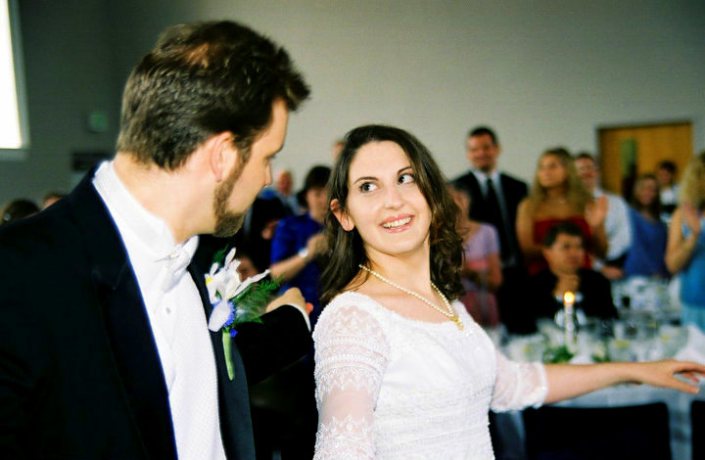
Ten years ago today, Nicole Ann Boury married me. After ten years, I’m still not entirely sure why she did it. I know I haven’t always made her happy. I know I’ve many times made her unhappy. But even through all the uncertainty and instability of the past ten years—which is not very much for some, but is for us—we still belong.
Over this past decade, there have been a good many things we used to have in common that we no longer do. Life changed us. We got bored with some things. We discovered new things. We discovered that stuff we thought we had in common really wasn’t. One by one, our preconceptions of what married life is supposed to be have come to light. Many have been set aside. But we still belong, and this marriage is ours.
As I’ve spent nearly the past eight years as an ordained cleric, my understanding of marriage has been clarified by my experience in the diaconate and the priesthood. Ordination is a gift, not a right, and it mainly consists of duties and calling, not of desires and personal dreams and hopes for fulfillment. Certainly, each of us in holy orders brings his own particular style and emphases to the vocation, but we nevertheless do not call ourselves. And we can indeed be un-called. The same holds true for marriage. In both marriage and ordination, there is a walk around an altar or its analogue, and in those steps, three times around, the walkers are changed. They now belong to something larger than themselves, to which they are responsible, something they did not invent and cannot reinvent.
I’m not sure when I’ll ever be very good at either of these ordinations I’ve been given—husband and (then) priest (a temporal order that is deliberate and necessary)—but they’re what I’ve been given, and so I have to do them.
What we’ve found along the way as our things in common have gradually gone by the wayside is that what we have in common that is far greater than any of these other things is the community that God has founded in and through us. We now have three children, each with his or her own personality, habits, delights and challenges. And as much as I cannot imagine life without Nicole, I also now cannot imagine life without them. I want them to exist, and life before their existence in retrospect seems diminished.
I deal with broken relationships all the time, whether pastorally or personally, and the tragedy of that brokenness affects me, even if it is “only” the tragedy of death, where the relationship’s brokenness is not the fault of anyone involved but is the price that continues to be paid for the sin of Adam and Eve. I thank God that that tragedy has not entered into our home, and I must admit a certain degree of fear when I imagine it.
I love my wife. I love my kids. I thank God for them all. I do not know whether I will ever be very good at loving them. It always seems not quite enough, not quite the right thing. Grand plans in my head all just sort of fizzle out. Yet somehow we have this decade, and in it we’ve lived in six different homes, brought three children into the world, survived seminary, served in two different parishes, said farewell too many times to too many people (too many of them, until the next life), lost hair, gained weight, lost weight, lost friends, gained friends, gained family, finally bought a house, finally started planting a garden, finally started thinking really long-term. Finally. Finally.
 But so much more to go.
This has been our decade, though—a gift, but given for us and for our salvation. For growth. For holiness. And it seems sometimes that we have only just made a beginning. The Fathers say that that is enough. And I have hope that it is—a hope for belonging.
I love my wife, and I hope she keeps forgiving me, and I hope I keep learning how to forgive and how to repent. Because someday everything will make sense. Because everything we do in this life is for that Day, that bright, bright Day.
Unto ages of ages. Finally to belong.
Share this:
Rootedness and Uprootedness: A Lament
In the past few weeks, I’ve learned of impending relocations of more relatives west of the Mississippi River, including one family that has been in the same state for decades and one elderly relative who has even been in the same house since the mid-1960s. One by one or in clumps, over the past several years it seems that both sides of my family (or at least the parts I stayed in touch with) are gradually relocating at least two time zones to the west, with all indications that they mean the move to be permanent.
I couldn’t quite place how I felt about all that when I learned it. It seemed a combination of anger, disappointment, betrayal, regret, helplessness and loss all bound up together into one unnameable emotion.
I don’t blame the individual members for their reasons, to be sure. For some, it is for work. For some, it is health. For others, it is simply a desire for a major change of scenery they’ve never had before. For still others, it is to be close to those who were already headed that way. And even though we haven’t lived less than hundreds of miles from most of them for many years, this series of relocations seems to me far more tragic than when we at least lived in the same time zone, within a day’s drive.
It all seems just wrong, like a violation of some sort. And of course, I suppose I have little room to talk. I ran off and went to seminary, offering up my locus and domus on a platter to the hierarchy like a good soldier. I just happened to get assigned to my native time zone at something relatively near my accustomed latitude. So my loyalty to—what, exactly?—only remains vaguely intact for reasons mainly beyond my control. But I still nevertheless feel that it is right I should be here (even though it is no credit to me) and that my family ought to be somewhere accessible to me and to my children. Shouldn’t they be allowed to know them?
Again, I am not blaming any of them individually or even as a group. Their reasons are all pretty decent reasons. But for many of them—for many of us, I should say—there is nothing to violate. There is no home. There is no hometown. There is no ancestral land, no place where we all once were from, no place to go back home to. There’s just nothing.
For generations now, my family on both sides has been mobile. They usually didn’t head this far out, to be sure, but they were mobile. There hasn’t been a home for… well, I don’t exactly know how long. Maybe a century. Home seems to me some kind of artifact hanging on the wall of a museum, fashioned by hands long cold and dead. I can see it and see how beautiful it is, but I can’t quite touch it. It is out of reach, behind the glass, above my head, somewhere else. But not here.
One of the curiosities of what it means to experience the peoples of Orthodox Christianity in America is that we are always encountering immigration. In one form or another, immigration touches everything we do. Everyone here either is or knows someone who is far from home, who has left family behind somewhere, stranded on a map somewhere. We continually are confronted by uprootedness, an unsettled restlessness where the heart is always somewhere else. But even the immigrant has a home, a place to locate his heart, even if it is not here. I’m not really sure what my family has. It’s not that.
My wife and I made a commitment to try to give our children this thing we’ve never had—a home. It’s kind of laughable, though, isn’t it? I’ve moved twenty-two times, and she’s moved twenty-three. We’re not experts on home, not by a long shot. But we want roots. I want them really badly.
Roots are a curious thing, though, something that can take generations really to put down, even for trees. And some trees will never come to their full glory within the lifetime of those who plant them. I feel that way sometimes about my now 15-year-old move into Orthodoxy. I know so many families whose whole lives are bound up in this faith, bound together with cords that are centuries old, and I am deeply covetous. I don’t know of anything that binds my family together like that. Even though most of them are all Evangelicals of one sort or another, they’re distributed nearly randomly among a post-denominational handful of churches that happen to be close to them and are mainly the kind of thing they’re used to.
But I dream of “the Orthodox Damicks,” and I don’t know if I will ever see such a thing. Right now, we are the only ones. Will my children remain in the Church? Will they marry Orthodox Christians and raise Orthodox Christians? Will they know Emmaus as their home and remain in the Lehigh Valley so that we all will celebrate Pascha and Christmas and Theophany together, so that I will get to baptize and marry them, so that many cousins will go to church together, so that love will not only be something we do over the telephone?
Forgive me all this. I know it’s self-indulgent. But I do have a point in all this. Even though it’s true that we have no continuing city, that we seek the one to come, we best reflect and preach that city that is to come by making the homes we have into Paradise as much as we are able.
I think it will be long after I am dead before the Orthodox Damicks will have their earthly Paradise, at least the incomplete, contingent one that will help them along to salvation toward the true Paradise. But like a monk I know once told me, you still plant the tree, even though you know it may be a century before it’s truly grown.
Gardening is hard. We do it anyway.
