Orthodox Youth Movement
Facing Antioch: Hopes for the Antiochian Archdiocese Nominating Convention and Beyond
We in the Antiochian Orthodox Christian Archdiocese of North America come now to a historic moment, one that has not been seen for nearly half a century. That may sound a bit melodramatic, especially considering that we are really only a small community, both when compared with the rest of our country and especially when compared with the Orthodox world in general. But it is nevertheless historic for us, and there are many parties outside our archdiocese who are interested in what is happening for us right now.
I’ve twice written previously on my thoughts about our future:
- Light from Antioch: The Future of the Antiochian Archdiocese and Orthodoxy in America
- “We speak one language: Antiochian”: More Thoughts on the Future of the Antiochian Archdiocese and Orthodoxy in America
In this final post in this series before our special nominating convention which will take place in just a few days, I’d like to focus on what my hopes are for our future specifically in terms of one central theme: spiritual renewal.
When the Orthodox Youth Movement was founded in the Middle East in 1942, its founders observed that church life in their place and time had largely devolved for the faithful into a kind of “institutional” relation to the Church. In 1964, Metropolitan Georges (Khodr) wrote about that time:
Popular piety, like the piety of other Mediterranean Christians, is profoundly ritualistic. Service books and diverse manuals of devotion put the allegorical and spiritual meaning of the Liturgy into relief, but the psychology of the ordinary Christian remains dominated by the sensual and aesthetic aspect of the Offices. The great majority of the faithful do not penetrate in any way into the spiritual significance of the rite. They often bring with them authentic private piety, but a sense of the liturgical community and of the bond between the individual person and the praying assembly is rarely consciously experienced by the majority of the faithful.
(A Sign of God: Orthodoxy 1964: A Pan-Orthodox Symposium, pp. 266-67, as noted in a recent podcast by Nicholas Chapman)
How many of us have seen this same thing in our own parishes? The great majority of the faithful—and I do mean here the faithful, and not the nominal, who bear the name of Orthodoxy but have little to do with church life—do not really relate to the worship of the Church in a genuinely engaged and personal way. The chanting is beautiful, the sermon is inspiring, the iconography is beautiful, the feeling is moving, etc., but the theological and spiritual character of the Church’s services and inner life is largely absent from most of the faithful’s experience.
How did this come to be? I think it is a temptation for all religions but especially liturgical ones for people to “institutionalize” their membership, and Orthodoxy is no exception. The faithful can attend services, even faithfully, work in various parish activities, fast consistently, say their morning and evening prayers, etc., but have little in the way of that genuine engagement with the meaningful content of the worship services and the whole of spiritual life. What was intended by Christ as a mystagogy—a spiritual initiation into a new life—becomes “church membership.”
Such devolution of church life is not, I think, anyone’s conscious decision but rather the result of what one might call a kind of spiritual entropy, the gradual decay that comes when a community is not watered with the blood of martyrdom, whether literal or figurative. So what is needed is a new martyrdom. Christianity is the only faith whose central act is the martyrdom of its God. And since we humans become like whatever we worship, we Christians are all becoming martyrs, “witnesses” to the death, resurrection and ascension of Jesus Christ.
And since we in the Antiochian Archdiocese find ourselves in a place where we can assess where we have been and where we are going, it seems to me that now is the time to ask ourselves what that martyrdom will look like, how we can be renewed.
As I’ve been able to find relevant translated materials (which are not extensive), I have lately been exploring some of the lessons of renewal that can be learned from the Orthodox Youth Movement—which still exists, by the way, and even has its own ongoing internal conversation about “a renewal of the renewal,” since it is now some 72 years old. It had many effects in church life in the Middle East, most of which are almost entirely positive. As I noted in my first post in this series on the American Antiochian future, it resulted in a marked increase in religious education, monastic vocation, asceticism, more vigorous parish life, etc.
That is a lot to contemplate all at once, but from the words of Metropolitan Georges above, the real emphasis of the Movement that is its genius is a sense of personal engagement with the life and spirituality of the Church’s tradition. One has to begin there before one can contemplate too deeply questions of larger structural changes. We can build all kinds of institutions and programs, but if there is not underlying them the character of genuine Christian love for Christ and one another and a theological revival in every sense, they will be like the “fast of demons,” which is strong and undeniable yet not vivified by faith.
As I’ve learned more about this approach to church life, I’ve come to decide that in my own parish community, we are going to be exploring how we can find this renewal for ourselves. The vehicle we’re using for this is the Fellowship of St. John the Divine, a lay organization of the archdiocese with chapters in many parishes. (In some ways, the FSJD parallels the OYM.) It is not so much that we are dead or stultified, etc., but that, just as Metropolitan Georges observed 50 years ago, we have a lot of “institutionalized” relating to the Church going on. It’s not everyone, but it’s enough that it is a real concern. So we’re adopting two practices over the next months:
- The full list of every person associated with the parish has been divided up into parts and distributed to members of the Fellowship of St. John the Divine for daily prayer. Every person in the parish will be prayed for every day.
- Once a month, the Fellowship will come together, not for a business meeting or for a class, but for a time of intercessory prayer and one other spiritual practice. The latter may include: a brief meditation on a scriptural or patristic quote, saying the Jesus Prayer together (probably with one person saying it out loud; this is a practice of some Athonite sketes) or reading the Psalms out loud to one another.
We need spiritual renewal, both individually and corporately. It is not that the faithful are unfaithful, but perhaps they have never been taught about this kind of personal engagement with the depths of Orthodox tradition. Perhaps they have never seen what it looks like. So we are going to be doing some of those things at St. Paul’s in Emmaus, Pennsylvania.
So where does this leave the question of where we as an archdiocese are going, especially in terms of our new Metropolitan Archbishop? If he were to ask me what I would like to see to initiate spiritual renewal for all of us, what would I say?
There are a lot of things I could mention, but there are three in particular that I hope for in the next chapter of the life of the Antiochian Orthodox Christian Archdiocese of North America:
- An emphasis on monasticism: Not only will this provide a deeper “bench” for episcopal candidates (it’s not very deep at the moment), but monasticism provides a living and radical witness to all the faithful of what personal engagement with the faith can be like.
- Bringing the lessons of the Orthodox Youth Movement to North America: The OYM is now the official youth organization of the Patriarchate of Antioch. It has no presence in North America. Perhaps the key here would be to re-tool Teen SOYO and the Fellowship of St. John the Divine to reflect what the OYM has learned over the years. (The OYM of course has its own internal controversies and is sometimes controversial within the patriarchate, but that doesn’t cancel out its overall contribution to church life.)
- Opening the lines of communication to Antioch: I’ve written before (here and here) about why we—and all Orthodox Christians in America—need access to the spiritual riches of Orthodoxy in the Middle East. We need to hear from them, and they need to hear from us. There needs to be more translation going on, more media, more connection across the Atlantic.
So, that’s my “wishlist.” I have no idea who our next Metropolitan might be. Especially from what I have seen of the Patriarch and the Holy Synod of Antioch, I trust them to elect the man whom God has in mind. And my hope for our nominating convention this week is not just that we would vote, wanting this man or that, but that we would be gathering in a churchly manner, the royal priesthood of God, aware spiritually of one another, connecting spiritually to one another, and uniting our prayers for inspiration from the Holy Spirit to move in all of us in a new and beautiful way.
Pentecost is coming!
Share this:

Light from Antioch: The Future of the Antiochian Archdiocese and Orthodoxy in America
Notes: The following is a personal reflection and represents only my own views. This piece is also available as an audio recording via Ancient Faith Radio.
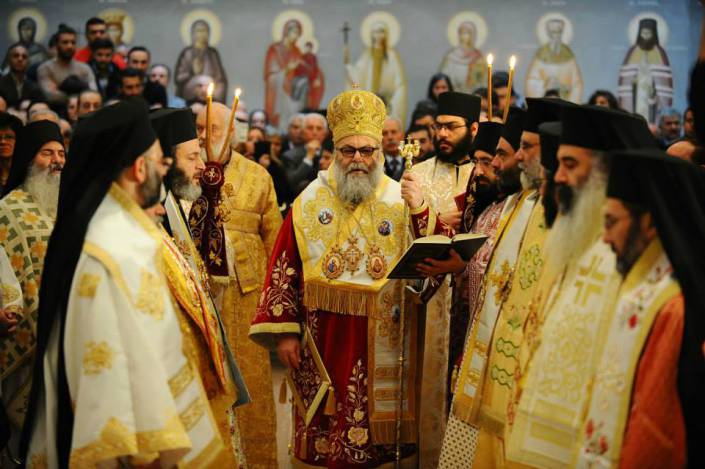
This past Friday, I had the blessing along with other clergy of the Diocese of Charleston and Oakland and also the Diocese of Washington and New York to meet with His Eminence, Metropolitan Silouan (Moussi) of Argentina in Washington, DC. Sayidna Silouan’s purpose in calling this meeting, as well as many other similar meetings throughout North America, was to hear the voices of the clergy and faithful of the Antiochian Archdiocese of North America, to hear what they yearned for in their future, in the light of the transition that is now upon us, namely, that within a couple of months we will be in the care of a new Metropolitan. +Silouan’s role here in North America is Patriarchal Vicar, and he is essentially in charge of the archdiocese until a new Metropolitan is elected. He serves as the voice of the Patriarch of Antioch in our midst.
The table where we met seemed to be mostly filled with listeners (which is a good thing in the clergy), but a few of us spoke when Metropolitan Silouan asked us directly to tell him what our hopes were. In his initial remarks on this, he said something that stuck with me: “Thinking according to the constitution is good, but thinking as the Church is better.” I’ll say more on that in a moment.
The other clergy who spoke mainly talked of their desire for the unity of the archdiocese to be kept intact, that we should not be divided. And +Silouan mentioned that he had been seeing peace everywhere in the archdiocese, wherever he went, that no one had to tell us to be unified and at peace, but that we simply were. And I have noted that this theme seems to be repeated in a number of the conversations between Antiochians I have been privy to. I have also noticed in my more than 16 years of experience in the archdiocese that there really is a common identity, a brotherhood among us. It would be a shame for that to be harmed in any way.
Some seem to believe that that unity would be harmed if, for instance, the archdiocese were divided into multiple metropolitan districts, “every bishop doing his own thing” in the words of one comment I read online. And that is typically contrasted with the system we have recently had, namely, a single ruling metropolitan with auxiliary bishops who served entirely at his blessing.
We also had a different system in place for a few years after the grant of self-rule, which was another iteration of the vision of Metropolitan Philip for our archdiocesan unity—diocesan bishops with more of their own authority in their dioceses, yet with a strong metropolitan at the head of the archdiocese. This was actually a traditional metropolitical system, in which the bishops on a synod do everything “with him who is first,” while the one who is first also does what he does with the consent of all. And it’s clear to me from my reading of Church history that there are many possible models that we could adopt which need not be read as “dividing the archdiocese.”
The exact details of how bishops who sit together on a synod presided over by their metropolitan can all work together and remain united and still have authority emphasized on the primate can have lots of different sets of details to define them. (Examples: Are finances shared? Is authorization of ordinations centralized? Can each diocese have its own educational institutions? Can bishops found churches and monasteries on their own?) I don’t see why any conversation about these things has to devolve into only two iterations—1) a sovereign metropolitan with auxiliaries or 2) fully independent dioceses each headed by a bishop who owes no particular allegiance to the metropolitan. These things sit along a continuum with numerous points in between, and they can all contribute to the question of unity.
This kind of thing seems to be on many people’s minds. But I have to admit that what comes to my mind when I think about the unity of the Antiochian Archdiocese and what came to my mind especially when Metropolitan Silouan asked us what we wanted for our future didn’t really have much to do with all these administrative details that are, to be honest, above my pay grade and not in my purview. I’m just a parish priest.
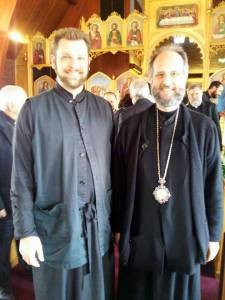 But +Silouan’s words stuck in my mind:
“Thinking according to the constitution is good, but thinking as the Church is better.”
I do not mean this as any slight to my brothers and sisters, but it seems to me that, while discussion about administrative details and rules (“thinking according to the constitution”) is important, there is something of greater importance that I hope will become more part of our conversations, especially as we head toward our special nominating convention on June 5. And what is that? It is our spiritual inheritance as Antiochian Orthodox Christians.
We rightly often speak of Ss. Peter and Paul and Ignatius of Antioch, and I love those parts of our tradition. But there is actually a great wealth of spiritual riches that have been developing in the Antiochian Church recently, as well, and it is almost entirely unknown to Antiochians in America.
To give but one example of this, one of the major developments of the 20th century in the patriarchate was the founding of the Orthodox Youth Movement. This movement was founded in the 1940s and was the instrument of an astonishing spiritual renewal over the decades that followed. It not only produced abbots, bishops and even patriarchs (Patriarch Ignatius IV was one of the founders of the movement), but it began church schools, founded and revitalized monasteries, emphasized personal holiness and asceticism, and rapidly expanded theological education throughout the patriarchate. It was a powerful and thoroughgoing reform movement that radically reshaped a church that, sad to say, had been moribund with nominalism for quite some time.
The results of the Orthodox Youth Movement, which celebrated its 70th anniversary in 2012, are a vital and spiritually rich Antiochian church in the Middle East, a church which even now is showing its spiritual strength as it endures crucifixion anew. Thanks in large part to the movement, there are now monasteries where there were none. There are charitable programs where there were none. There is theological education. There are holy elders. There are not just old monasteries that were previously on the brink of abandonment and are now filled with monastics, but there are even new monasteries.
And most Antiochians on this continent have no idea about any of this. Much of it, I only learned about recently myself.
So what did I say to Metropolitan Silouan when he asked us what our hopes were?
My hope for the future of the Antiochian Archdiocese of North America is that we can receive some of these great spiritual riches.
 Why is it that an Orthodox Christian in America can easily access the 20th century holiness of Elder Paisios, Elder Sophrony, St. Silouan, St. Porphyrios, St. John of Kronstadt, Elder Cleopa, etc., and not feel that they are becoming Hellenized, Russified, Romanianized, etc.? These holy people are naturally attractive to us, because they are saints, and their holiness transcends cultural barriers. But why are we almost entirely ignorant of the immense spiritual power of Orthodox Christianity in the Middle East?
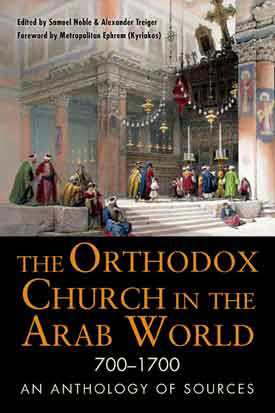
There are probably a lot of answers to that question. One of them is that not much is getting translated from Arabic to English. We are blessed to have the Notes on Arab Orthodoxy weblog to help us connect to that great spiritual wealth, and its author has recently contributed to a new volume to help us connect with some of that historical inheritance, too: The Orthodox Church in the Arab World 700-1700: An Anthology of Sources (a wonderful book I recently got a copy of, by the way). But there needs to be more of that kind of thing—a lot more.
There is a beautiful, vast treasure trove of Antiochian spirituality that most Orthodox Christians in America—even Antiochians—are mostly unaware of.
One of the things that has struck me profoundly during the past several weeks since our father Metropolitan Philip reposed in the Lord is how immediately and how refreshingly our patriarchate has become involved with us. I am not part of the “administration,” but I have not felt for one moment that we were “under” some “foreign bishops” during this process (something one often hears within Orthodoxy in America). Rather, my feeling has been that we are being attended to as family by family, that we are being loved by spiritual fathers who really care what happens to us.
All this brings us to the question of what this attention from the patriarchate might mean. It certainly has not seemed to me to be overbearing in any way. Some have suggested that it means that the patriarchate wants to draw us closer to itself so that there may be more solidarity between us. Some fear that this may mean “Arabization” (for whatever that might mean). Some fear that this may put administrative unity in Orthodoxy in America in some jeopardy, i.e., if the American Antiochians become more Antiochian, they will be less American.
I cannot answer all of those fears, because I do not know what the future holds. But I will give one example to address one of them. For some folks, “Arabization” might mean a new emphasis on the Arabic language in worship. That would of course be a tall order, since roughly 3/4 of our clergy are converts and most converts have no knowledge of Arabic. But I do not think it would be ordered at all, to be honest. We have a patriarchate that has parishes in Turkey, just over the border from Syria, that worship in Turkish—not Arabic. We also have a patriarch who, when he was assisting with parishes in Europe, insisted on taking an intensive English language course so that he could both liturgize and preach in English before he visited any parishes in the United Kingdom.
What I would like to see is a new infusion of the spirit of Antioch, a new and increasing access to these spiritual riches—Middle Eastern saints and elders, monasticism, vigorous and traditional Byzantine music education, mutual visits, etc. In short, we are a family that needs to become closer.
None of this is meant to be a criticism of Metropolitan Philip, by the way. He was the man for his time—a great man—and he accomplished many remarkable things. And I felt a personal loss at his death. At the same time, I am also reminded of words spoken by Archbishop Joseph at Sayidna Philip’s burial, when he was speaking of what the new Metropolitan would need to do:
“David fought the wars, but Solomon built the Temple.”
I don’t pretend to know exactly what he intended that to mean, but one interpretation that occurs to me is that +Philip fought many wars and was a victorious warrior. And the next Metropolitan now has an opportunity to take us to another level, a place where the spiritual depth of Antioch is brought to us in even greater power.
So what does all this mean for our fellow Orthodox Christians here in America who may wonder if the Antiochians might become too preoccupied with being Antiochian to be as concerned with administrative unity?
Just as all the other Orthodox traditions in America each have their own contribution to make to the Orthodox Church here, the Antiochians do, as well. And we should bring our very best to the table. Frankly, there is a lot in our own tradition that we haven’t accessed yet. And I want it for myself and for my own children. And it’s not out of any ethnic sentiment on my part that I want it—I’m Lithuanian (though I barely know what that means). I want this stuff because it’s a whole world of holiness to explore.
So that brings me to my final point, which I believe answers both the question of unity in the Antiochian Archdiocese and also unity within Orthodoxy in America:
The more authentically Orthodox Christian we become, the more united we will be.
The root of all division is sin. And the basis for all true brotherhood in Christ is holiness. It’s really pretty simple. So if each of us adheres more closely to what is best within each of our traditions (without ignoring other traditions, of course), then we will become one. Administrative issues are really secondary to the question of spiritual renewal, and if there is authentic spiritual renewal, the administrative issues will work themselves out a lot more easily.
So my hope is this: If anyone in the Holy Synod may happen to read this, and if any Antiochian or any Orthodox Christian happens to read this, that all our prayers will be joined together in the Holy Spirit so that the outcome of the next couple months’ deliberations pertaining to the Antiochian Archdiocese of North America is this:
Whatever might happen with the election of a Metropolitan or even questions of how we are to be administered, may it open up new channels for the abundant streams of grace from the Antiochian tradition to flow to us here in North America.
May God’s will be done.
